
Solar panel cleaning equipment at a glance: kits, brushes and professional technology
From the 100-euro kit to the reverse osmosis unit: what equipment is available, what it really costs – and at what point a professional makes more financial sense than buying.
AI
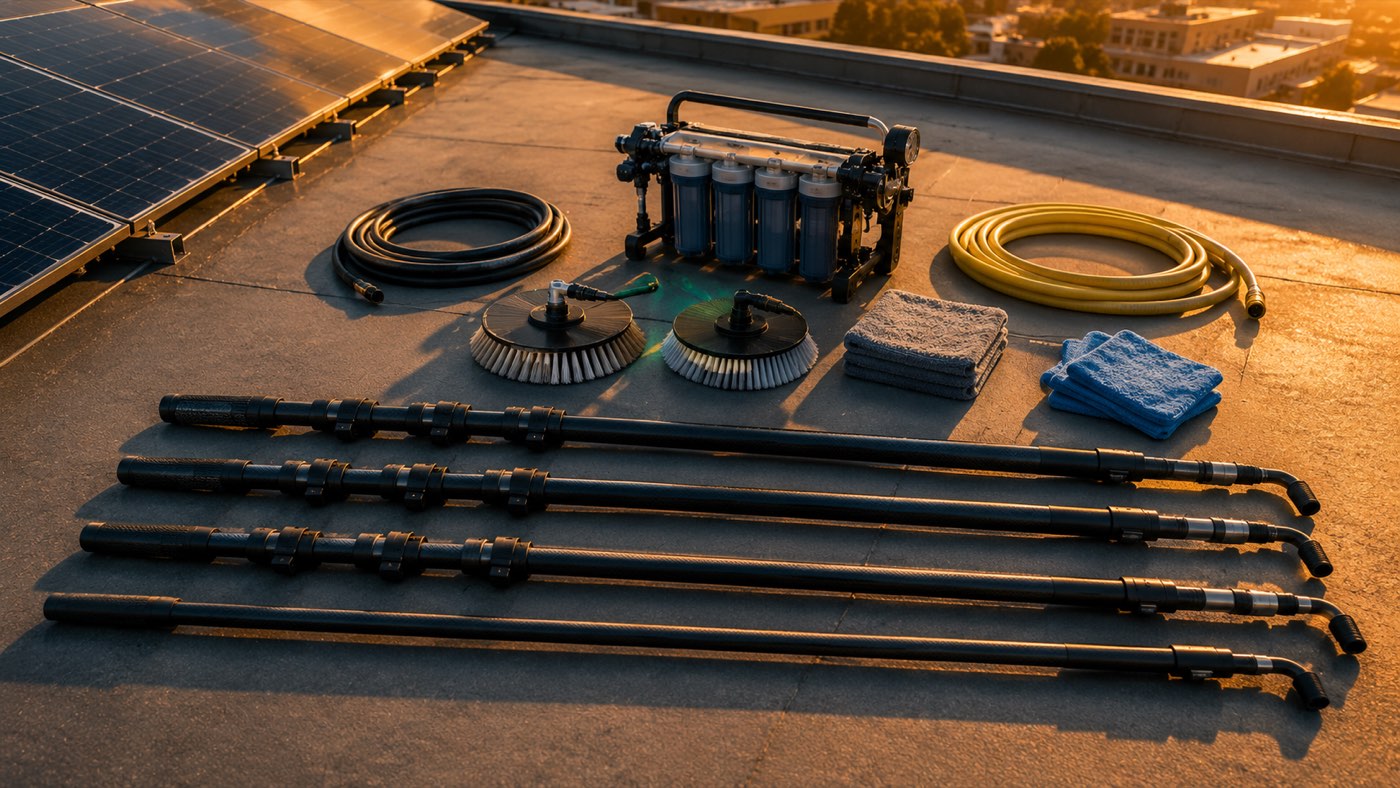
The range of solar panel cleaning equipment runs from a simple wash brush on a telescopic pole for around 100 euros to a mobile reverse osmosis unit costing several thousand euros. Four categories cover practically everything: water-fed telescopic poles, cleaning brushes for solar panels (fixed or rotating), complete cleaning kits, and pure-water or reverse osmosis technology. On top of that, there are robots and drones – specialist technology for large systems.
First, the honest answer to the most common question: for a family home whose panels only need cleaning every few years, buying equipment is rarely cost-effective. Equipment that cleans streak-free and in line with manufacturers’ instructions starts at around 1,200 euros excl. VAT – a professional clean with us costs a fixed 249 euros. This overview with real market prices shows which equipment is still worthwhile, and for what purpose.
Solar panel cleaning equipment: the four categories and their prices
Before we go into detail, here is the market at a glance. The prices are guide prices from German-language specialist shops (as of July 2026, sources at the end of the article):
| Equipment category | Price range | Suitable for |
|---|---|---|
| Simple wash brush with telescopic pole | from approx. €100 | plug-in balcony solar kits, panels within reach at ground level |
| Water-fed telescopic pole (aluminium to carbon, ~6 m) | approx. €85–€1,050 | the basis of any set-up, working from the ground |
| Rotating solar panel cleaning brush | approx. €1,240–€2,300 | larger areas, professional use |
| Cleaning kit with pure-water filter | from approx. €1,200 | keen DIY cleaners with safe access |
| Mobile reverse osmosis unit (professional) | from approx. €3,500 | cleaning businesses, regular large-scale jobs |
What stands out is the gap of more than 1,000 euros between the DIY-store kit and the first equipment that is genuinely up to the job. The reason lies in the water – more on that shortly.
Water-fed telescopic poles: the basis of any set-up
Every serious piece of solar panel cleaning equipment is mounted on a telescopic pole that carries the water straight to the brush. Two things matter most: reach and weight. A typical house roof quickly calls for a working length of 6 to 10 metres, and this is exactly where the material separates the wheat from the chaff:
- Aluminium poles (approx. €85 at ~6 m): inexpensive, but heavy and prone to flexing – at full length, guiding the brush becomes a test of strength.
- Glass-fibre poles (approx. €160): lighter, but still considerably less stiff than carbon.
- Carbon-fibre poles (approx. €650–€1,050): stiff and light enough for precise, fatigue-free work, even at 10 metres. That is why they are the professional standard.
If you only occasionally clean panels at ground level, aluminium will do. For roof work from the ground, there is practically no alternative to carbon – and that is where the price of the equipment really starts to climb.
Cleaning brushes for solar panels: fixed or rotating
The solar panel cleaning brush itself comes in two basic types. The fixed solar brush with soft bristles is guided over the panel by hand – simple and robust, but hard work on stuck-on deposits. The rotating brush loosens the film of dirt mechanically and covers many times the area: according to the manufacturer, professional units such as the SOLA-TECS C 800 clean up to 300 m² per hour and cost around 2,300 euros excl. VAT.
One detail surprises many people: quite a few rotating solar panel cleaning brushes – such as the Kärcher iSolar series (from approx. €1,240) or the SOLA-TECS C – use the water pressure from a pressure washer as their drive. The pressure of 100 to 120 bar only drives the brush roller; the water reaches the panel glass through the soft bristles, not as a jet. That is the crucial difference from a direct high-pressure jet, which all panel manufacturers advise against – why a pressure washer on its own has no place on panels is explained in a separate article.
In short: Cleaning brushes for solar panels must have soft bristles designed for solar glass. Hard brushes, scrapers and scouring sponges cause microscratches in the anti-reflective coating – damage that is permanent and can put the manufacturer’s warranty at risk.
Solar panel cleaning kits: from the DIY-store kit to professional equipment
A solar panel cleaning kit sounds like a convenient all-in-one solution – but its quality depends almost entirely on whether it provides demineralised water. Simple kits for around 100 euros (wash brush plus 4.6-metre telescopic pole) work with tap water. The problem: Vienna’s tap water is moderately hard, and its minerals dry on the glass, leaving a limescale film – and that film in turn absorbs light. Anyone who “cleans” like this swaps old dirt for a new deposit.
That is why usable entry-level kits combine a water-fed carbon pole with a pure-water filter: a kit consisting of a resin filter (such as Unger HydroPower), a 6.7-metre carbon pole and a solar brush costs around 1,195 euros excl. VAT. With it, you can work chemical-free and streak-free – provided the panels can be reached safely from the ground.
And what about cleaning agents? Some kits are marketed with “solar cleaner” or nano additives. The panel manufacturers’ instructions take a different view: they specify low-mineral water and soft brushes and warn against aggressive or alkaline agents that attack the coating and seals. With the right water, additives are simply unnecessary – why reverse osmosis water works without chemicals is something we explain in detail.
Reverse osmosis units: the heart of every professional solar panel cleaning system
What sets a specialist company’s solar panel cleaning system apart from equipment for home use? Above all, the water treatment. Two techniques produce demineralised water:
- Resin filter (ion exchanger): compact, from a few hundred euros as part of a kit – but the resin is used up a little more with every litre and has to be bought again as a consumable. The harder the water, the faster this happens.
- Reverse osmosis unit: forces the water through a membrane and removes almost all minerals. Mobile professional units that deliver water at 0 ppm cost from around 3,500 euros.
If you add up a reverse osmosis unit (approx. €3,500), a rotating brush (approx. €2,300 excl. VAT) and long carbon poles (€650–€1,050), a business quickly reaches the mid four-figure range – and that is before the vehicle, water tank and fall protection. We use exactly this combination too: reverse osmosis water, rotating soft brushes and water-fed telescopic poles, following the panel manufacturers’ instructions step by step.
Robots and drones: specialist technology for large systems
For solar farms and large flat roofs, there are cleaning robots that travel along the rows of panels on their own, as well as cleaning drones, which are still a new niche. Both are technologies for operators and service providers with areas measured in hectares, not for a house roof – the purchase costs far exceed anything covered in this article. If the technology interests you, we have devoted separate articles to it: one on solar panel cleaning robots and one on cleaning by drone.
Buy, rent or have your panels cleaned? An honest cost comparison
Now for the key question. Depending on its location, a family home with a pitched roof needs about one clean every 2 to 5 years. Here are the options side by side:
| Option | Cost | What to bear in mind |
|---|---|---|
| Buying a cheap kit | from approx. €100 | tap water leaves a limescale film; reach usually too short for the roof |
| Buying suitable equipment | from approx. €1,200 excl. VAT | plus replacement resin, your own time, familiarisation – and the risk of falling stays with you |
| Renting equipment | varies widely | possible in some cases; collection, familiarisation and safety remain your concern |
| Professional cleaning (Zelano) | €249 fixed price incl. VAT | up to 10 kWp, incl. travel within Vienna & the surrounding area, reverse osmosis water and a visual check |
The maths is clear, if unspectacular: for the 1,200 euros you would spend on your first suitable equipment, you get more than five professional cleans at a fixed price of 249 euros. At intervals of 2 to 5 years, that covers 10 to 25 years of cleaning – longer than many a brush and resin fill will last, and without you having to go up on the roof yourself. The picture only changes if your panels can be reached safely at ground level and you enjoy doing the work yourself anyway.
For a clean every few years, a professional is usually cheaper than buying equipment – the equipment only pays for itself when it is in constant use.
What no equipment can replace: safety and manufacturers’ instructions
The catalogue price is not the whole story. If you clean your panels yourself, you also take on the responsibility that a specialist company includes in its price: in Austria, work on a pitched roof requires fall protection in accordance with ÖNORM B 3417, panels are live as long as light falls on them, and cold water on glass that is hot from the midday sun can cause thermal shock. Then there are the panel manufacturers’ cleaning instructions – ignoring them can cost you the warranty. What is realistically feasible with DIY cleaning – and what is not – is summarised in our guide Cleaning solar panels yourself. For everything else, there is our cleaning for family homes at a fixed price.
Frequently asked questions
How much does a solar panel cleaning kit cost?
Simple kits with a wash brush and a telescopic pole start at around 100 euros but only provide tap water. Usable kits with a pure-water filter and a water-fed carbon pole start at around 1,200 euros excl. VAT. Professional rotating brushes cost about 1,200 to 2,300 euros, and mobile reverse osmosis units from around 3,500 euros.
Which brush is suitable for solar panels?
Only soft brushes designed for solar glass. In their instructions, panel manufacturers such as Trina or Solarwatt specify soft brushes, sponges or cloths and low-mineral water. Hard bristles, scrapers and abrasive cleaners cause microscratches in the anti-reflective coating and can put the warranty at risk.
Can I clean my solar panels with a Kärcher?
Not with the high-pressure jet – all panel manufacturers advise against it, because the jet can break glass, loosen seals and force moisture into the laminate. Systems such as Kärcher iSolar use the pressure washer only to drive rotating soft brushes; the jet itself never hits the panel directly. However, brush heads like these cost from around 1,240 euros and are rarely cost-effective for private use.
Is it worth buying solar panel cleaning equipment for a family home?
Usually not. Equipment that cleans streak-free and in line with manufacturers’ instructions costs from around 1,200 euros excl. VAT – for the same money, you get more than five professional cleans at a fixed price of 249 euros. Since a house roof only needs cleaning every 2 to 5 years, depending on the location, that covers 10 to 25 years, with no risk to yourself on the roof.
Can you also rent solar panel cleaning equipment?
A few specialist dealers and rental platforms rent out telescopic poles or pure-water systems by the day, but rental is not widely available. Add up the rental fee, collection, familiarisation and your own time – and bear in mind that the risk of falling and the responsibility for working in line with manufacturers’ instructions remain with you.
- Solarreinigung Franken – buying advice on telescopic poles (prices for aluminium/glass fibre/carbon) (in German)
- Geizhals – Kärcher iSolar 800 Advanced (price comparison) (in German)
- Kärcher – iSolar 800 Advanced (how water-driven brushes work) (in German)
- pvneeds – Cleantecs SOLA-TECS C 800 (price and drive) (in German)
- Jeikner – complete solar panel cleaning kit BASIC (resin filter + carbon pole) (in German)
- OSA-Shop – Trion mobile reverse osmosis unit (price and output) (in German)
- Green Solar – wash brush with telescopic pole (entry-level price) (in German)
A question about your system?
Tell us the location, size and type of roof — you will get an assessment and a fixed price.