
AI
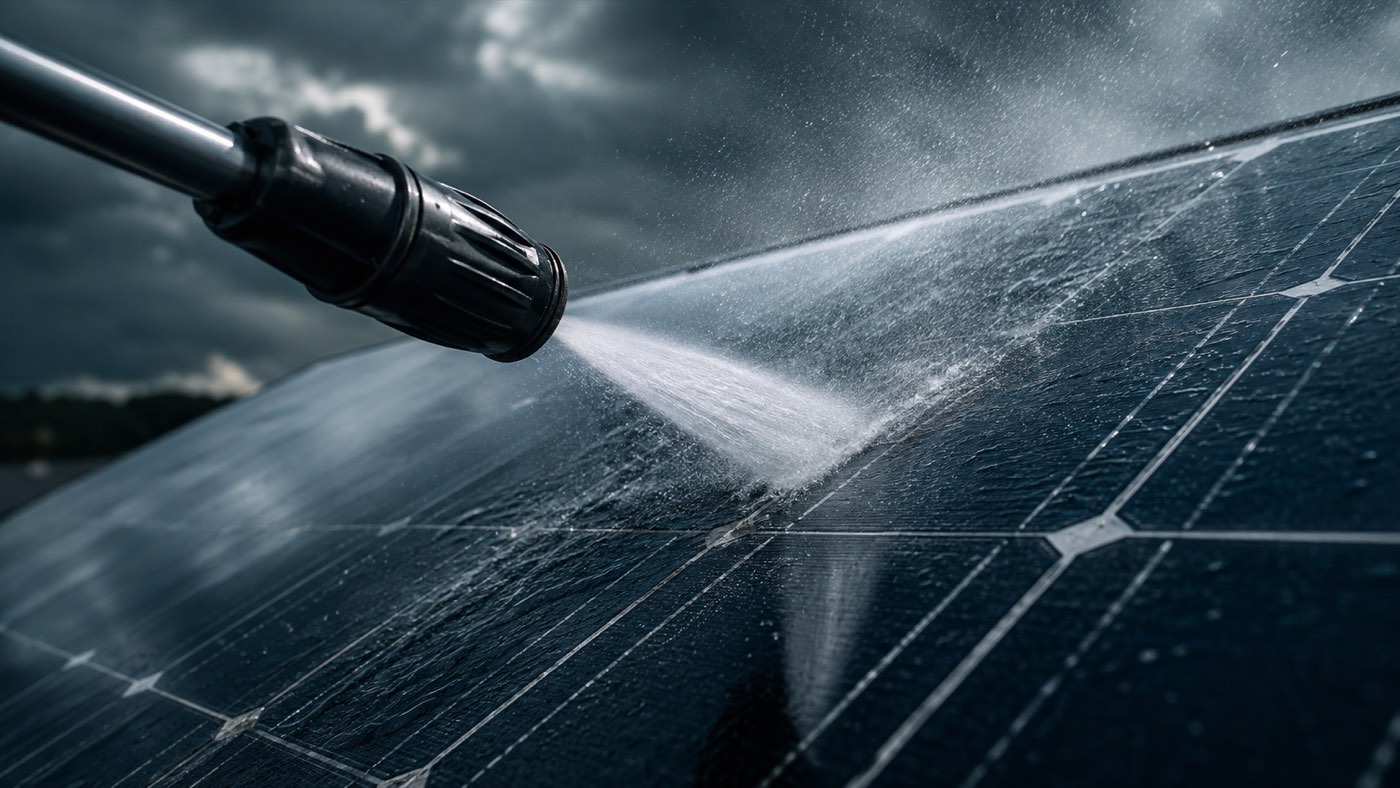
No – solar panels should never be cleaned with a pressure washer. The concentrated jet of water can break the panel glass, loosen frame seals and force moisture into the laminate. That is why panel manufacturers explicitly specify gentle methods in their instructions: soft brushes, sponges or cloths, and low-mineral water without pressure. If you ignore this, you risk not only damage but also your warranty claims.
This applies regardless of brand, model or pressure setting. Whether it is a compact model for home use or a professional machine running at 220 bar, any pressure jet is the wrong approach for solar panels – even from a distance, even with a wide nozzle. A look at the physics of the damage shows why.
Cleaning solar panels with a pressure washer: the damage the jet does
A solar panel is a composite of toughened glass, a frame, seals and a laminate in which the sensitive cells are embedded. This composite is designed for loads spread across its surface, such as snow or rain – not for a jet of water striking a single point. That is exactly where the damage begins:
- Broken glass and hairline cracks: The glass surface can break under the high pressure. Fine hairline cracks are more insidious: they remain invisible at first and only become noticeable later.
- Loosened seals: The sharp jet can make frame seals and joints leak. Once damaged, they let water into the panel every time it rains.
- Moisture in the laminate: If water gets inside, corrosion and delamination follow – the laminate comes apart layer by layer, and the cells suffer lasting damage.
- Frames and fixings: Brackets and frames can also work loose under the pressure; in extreme cases, a panel shifts out of its mounting.
The treacherous part is that much of this cannot be seen straight away. After high-pressure “cleaning”, a panel can look flawless and still be damaged. The moisture that has got in does its work over months, the yield falls gradually – and later it is hardly possible to trace the problem back to the cleaning.
“Kärcher” is not the problem – high pressure on panels is
Many people search for “Kärcher solar panels” – what they almost always mean is pressure washers in general, just as Austrians say “Tixo” for sticky tape. To be clear: the machines themselves are not to blame. On terraces, driveways or garden furniture, pressure washers of any brand do a good job. The problem is what they are used on: a bonded, sealed glass composite with electronics behind it.
Popular compromises do not help either. If you use a flat-jet nozzle, the lowest setting and a distance of two metres, you do reduce the pressure on the glass – but you are still working outside what the manufacturers permit in their instructions. And that is exactly what counts in a warranty claim.
What is permitted is what the manual says – not what the panel seems able to withstand.
What the manufacturers specify – and how the warranty is lost
The panel manufacturers’ cleaning instructions are surprisingly specific. In its instructions for the Vertex series, for example, Trina Solar permits only soft, clean cloths, sponges or soft-bristled brushes, prohibits steam cleaners as well as alkaline and strongly acidic solvents – and even stipulates that the temperature difference between the water and the panel must stay within a narrow range. This also rules out cold tap water on sun-heated glass: the thermal shock can crack it. Manufacturers such as Solarwatt have comparable requirements.
The warranty logic behind this is simple: the product and performance warranties cover damage that occurs despite proper use. The cleaning instructions in the manual define what proper use is. If a panel breaks as a result of high pressure, hard brushes or aggressive cleaning agents, that is not a matter for the warranty but self-inflicted damage – the manufacturer can reject claims. If a defect then appears years later, there is the awkward question of how the system has been treated all that time.
That is why, on every job, we record how the cleaning was done – in line with the manufacturers’ instructions, with before-and-after photos. We have also summarised the details of why incorrect cleaning costs more than it is worth in our article Cleaning solar panels yourself.
The alternative: reverse osmosis water instead of pressure
There is no question that cleaning itself is worthwhile – according to Wien Energie, dirty panels can generate up to 20% less electricity. It all comes down to the method. The answer that complies with the manufacturers’ instructions has two ingredients: water that cleans without pressure, and brushes that are softer than any household sponge.
We use reverse osmosis water from which almost all minerals have been removed. It dissolves dirt on its own, needs no chemicals and dries without leaving a limescale film or streaks. It is applied through rotating soft brushes, developed specifically for solar panels and mounted on water-fed telescopic poles – panel by panel, without pressure on the glass or seals. We show in detail how a job is carried out on our How we work page.
In short: No pressure jet, no chemicals, no cold water on hot glass. Soft brushes plus mineral-free water clean more thoroughly – and leave the warranty intact.
For family homes in Vienna and the surrounding area, by the way, this is not a question of budget: our solar panel cleaning for family homes costs a flat rate of 249 euros including VAT and travel – for systems up to 10 kWp. That is considerably cheaper than replacing a single panel damaged by high pressure.
Frequently asked questions
Can I clean my solar panels with a Kärcher?
No. “Kärcher” is used colloquially here to mean pressure washers of all brands – and none of them belongs on solar panels. The pressure jet can break glass, loosen seals and force moisture into the laminate. Panel manufacturers permit only soft brushes, sponges or cloths with low-mineral water.
How many bar can a solar panel withstand?
Manufacturers do not approve any pressure level at which a pressure washer would be allowed – what they permit is soft brushes and water without a pressure jet. Whether a machine runs at 110 or 220 bar makes no difference: even with a flat-jet nozzle and from a distance, the risk to the seals and glass remains, and the manufacturers’ instructions are breached.
I have already pressure-washed my panels – what now?
Check the panels for visible damage such as cracks, shifted panels or water marks behind the glass, and keep an eye on the yield in your monitoring app. Hairline cracks and moisture that has got in often only show up months later. If you notice anything unusual, a qualified electrical contractor should inspect the system.
Will I really lose my warranty if I clean incorrectly?
It is possible. The manufacturers’ instructions specify which cleaning methods are permitted; damage caused by improper methods such as high pressure, hard brushes or aggressive cleaning agents is not covered. If you clean according to the instructions, or have the cleaning done that way, your claims remain intact.
A question about your system?
Tell us the location, size and type of roof — you will get an assessment and a fixed price.