
AI
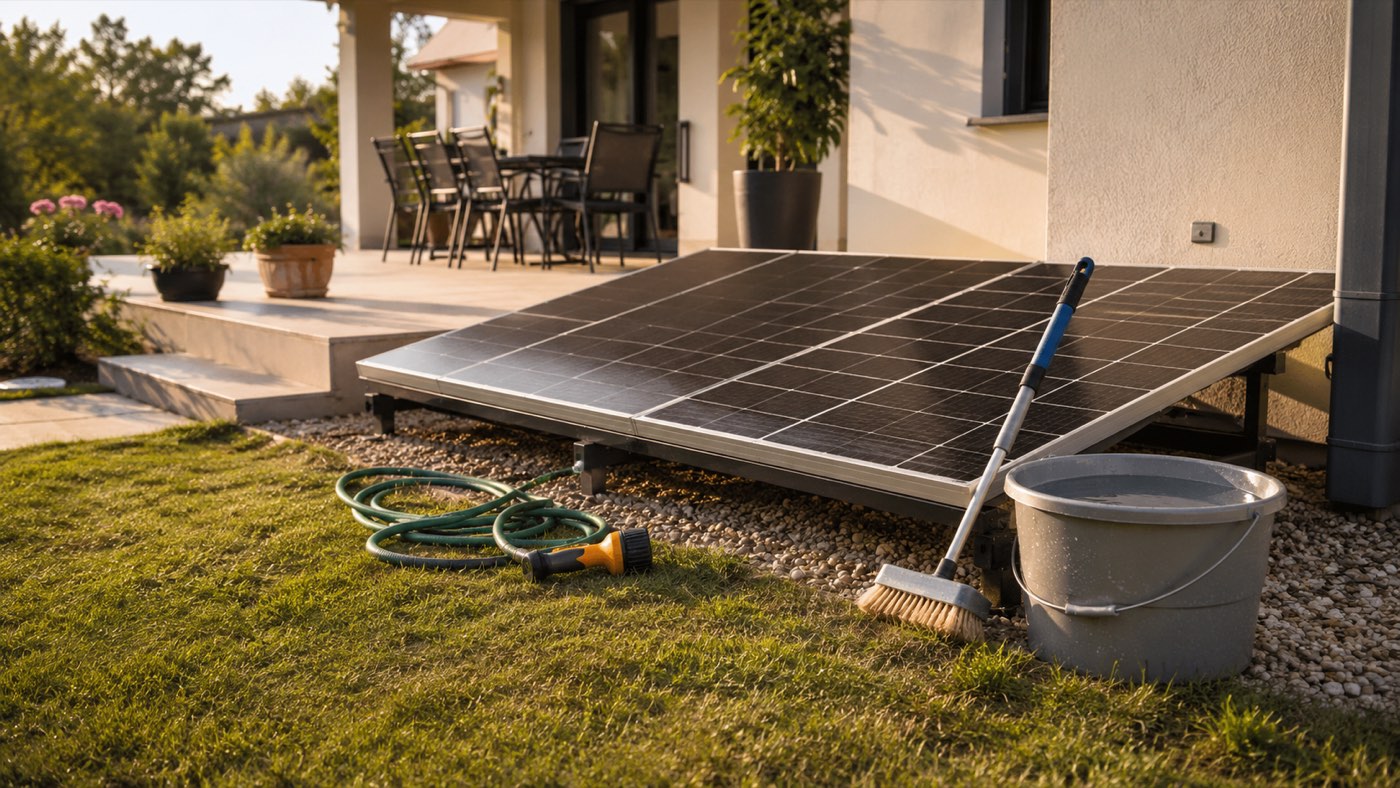
Yes, you may clean your solar panels yourself – it is not prohibited. But it only makes sense where you can work safely from the ground: on a plug-in balcony solar kit, on a carport, on a frame-mounted system in the garden. You need nothing more than a soft brush, plenty of demineralised water and a cloudy day – and, above all, nothing more is allowed: panel manufacturers specify exactly what may be used to clean them.
Anything beyond that is where the problems start. Household products such as washing-up liquid, glass cleaner or vinegar do more harm than good. Panels are live as soon as light falls on them – and that cannot be switched off. And the biggest risk is the most mundane: a fall from the roof. This guide draws an honest line between what you can do yourself and where a professional is the safer choice.
Cleaning your own solar panels: what is safe
If you want to do the cleaning yourself, there is just one condition you should take seriously: both feet stay on the ground. Plug-in balcony solar kits, panels on a carport or garden fence, frame-mounted systems close to the ground – you can clean all of these yourself with a clear conscience. Here is how to go about it:
- Choose a time when the panels are cool: early in the morning, in the evening or when the sky is overcast. Cold water on glass that is hot from the midday sun risks thermal shock and stress cracks – and leaves spots as it dries.
- Visual check: broken glass, loose connectors or damaged cables? Then do not clean – contact a specialist company instead.
- Rinse off loose dirt: with plenty of clear water and without any rubbing. That way, no grains of sand end up under the brush, where they would scratch.
- Clean gently, without pressure: use a soft brush, sponge or microfibre cloth with demineralised water from a DIY store – rainwater from the water butt is no alternative, because it contains dust and particles. Work without pressure and do not forget the bottom edge of the panel.
- Leave to dry: low-mineral water evaporates, leaving hardly any residue. There is no need to squeegee or polish afterwards.
In short: soft, pressure-free, low-mineral, cool. If you take these four words to heart when cleaning your solar panels, you cannot go wrong at ground level.
And how often? As needed, not by the calendar: when there is a visible film on the glass, a dirt line forms along the bottom edge or bird droppings are stuck to a panel. The latter should be removed promptly – bird droppings are the typical cause of hotspots, i.e. locally overheated cells.
Household products put to the test: washing-up liquid, glass cleaner, vinegar
The most common DIY cleaning mistake is a well-meant one: people clean the panels like a kitchen window. That is exactly what the manufacturers warn against. In its cleaning guide, for example, Solarwatt approves only soft brushes or sponges and clear water – harsh or corrosive cleaning agents are off limits, as is high-pressure equipment.
| Household product | The case against it |
|---|---|
| Washing-up liquid | Unnecessary and counterproductive: surfactants dry into a streaky film that new dirt clings to more easily. Over time, residues can put a strain on seals. |
| Glass cleaner | Contains alcohol or ammonia – can attack the anti-reflective coating and the frame seals. Not approved by any panel manufacturer. |
| Vinegar & citric acid | Acid has no business on seals and coatings. Counts as one of the “aggressive agents” that manufacturers’ instructions explicitly rule out. |
| Hard tap water | Vienna’s tap water is moderately hard: the minerals dry into a limescale film that in turn absorbs light. If you are going to use water, make it demineralised. |
| Pressure washer | The jet can break glass, loosen seals and force moisture into the laminate. Why the Kärcher is off limits is something we explain separately. |
The good news: you simply do not need any cleaning agent at all. Water that is very low in minerals dissolves dirt by itself and dries streak-free – for the same reason, professionals work with reverse osmosis water.
Risk of electric shock: live as soon as it gets light
One thing many people underestimate: a PV system cannot be “switched off” like an appliance. As soon as light falls on the cells, they generate DC voltage – even with the inverter turned off, because the inverter only disconnects the AC side. During the day, there is always voltage on the cables between the panels and the inverter.
To put this into perspective without causing panic: washing the outside of the glass surfaces is generally not a problem on an intact system – panels are built for rain. The danger lies in the combination of water and damage: a hairline crack in the glass, a pinched cable, a loose connector. That is why a visual check should come before every clean, and if you notice anything unusual, the rule is: hands off, call a qualified electrical contractor. As a matter of principle, electrical inspections and work on the system are a job for the electrical contractor – this applies to professionals and DIY enthusiasts alike.
The biggest risk is not the electricity – it is the roof
Objectively speaking, the most dangerous ingredient in solar panel cleaning is neither voltage nor chemicals, but height. Wet panel glass is extremely slippery, a leaning ladder is no place to work, and anyone who has to hold a pole, a hose and their balance at the same time has no hand to spare. That is why professionals work from the ground with water-fed telescopic poles, or on the roof with fall protection – with training and equipment for working at height.
Then there is the warranty risk: manufacturers specify in their instructions how their panels may be cleaned. Anyone who sets to work with a pressure washer, hard brushes or household chemicals puts their claims at risk if damage results – and scratches in the anti-reflective coating are irreversible. Cleaning the wrong way can therefore end up costing more than any professional clean.
Rule of thumb: anything you can reach without a ladder, you may clean yourself. Anything that would mean going up on the roof belongs in professional hands.
When a professional is essential
A professional clean can certainly pay off: according to Wien Energie, dirty panels produce up to 20 per cent less electricity, and a European study involving the German Aerospace Center (DLR) puts the average annual loss from soiling at around 5.3 per cent. When cleaning pays for itself is something we have worked out separately. You need a professional whenever one of these points applies:
- Rooftop system: any system that can only be reached by ladder or via the roof – because of the fall, electrical and warranty risks.
- Panels at a shallow tilt: below a tilt of about 15 degrees, self-cleaning by rain virtually stops working, and stubborn dirt lines and crusts build up.
- Stubborn deposits: no garden hose will shift baked-on bird-dropping stains, or moss and lichen on the frame edges – they have to be removed mechanically but gently.
At Zelano, we work with pure reverse osmosis water, rotating soft brushes and telescopic poles – following the panel manufacturers’ instructions, without chemicals. How a job is carried out is something we show you step by step. For family homes up to 10 kWp, there is a fixed price of 249 euros incl. VAT, including travel within Vienna and the surrounding area – all the details are on our solar panel cleaning prices page.
Frequently asked questions
Can I clean my solar panels myself?
Yes – provided you can reach the panels safely from the ground, for example with a plug-in balcony solar kit, on a carport or with a frame-mounted system in the garden. Use a soft brush or a microfibre cloth and demineralised water, work without pressure and only on cool panels. For rooftop systems, we advise against it: the risk of falling, the voltage on the panels and the warranty risk make a clear case for a professional.
Can I use washing-up liquid or glass cleaner on solar panels?
No. In their instructions, manufacturers such as Solarwatt or Trina approve only soft brushes or sponges and clear, low-mineral water – harsh or corrosive agents are ruled out. Washing-up liquid dries into a streaky film, and glass cleaner and vinegar can attack the anti-reflective coating and seals. Clean water that is low in limescale is all you need.
Do I have to switch off the PV system to clean it?
Panels cannot be switched off: as soon as light falls on them, DC voltage is present – even with the inverter switched off. Washing the outside of the glass surfaces is generally not a problem on an intact system. But check for broken glass or damaged cables first: if there is visible damage, do not clean – call a qualified electrical contractor instead. Electrical work is always a job for the electrical contractor.
What is the best way to clean a plug-in balcony solar kit?
With a soft brush, a sponge or microfibre cloth and plenty of demineralised water from a DIY store. Clean early in the morning, in the evening or when the sky is overcast, never on hot panels, and simply let the glass dry. No pressure, no household cleaners, no pressure washer.
A question about your system?
Tell us the location, size and type of roof — you will get an assessment and a fixed price.