
Bird droppings on solar panels: hotspots, fire risk and quick action
Why bird droppings are the most damaging kind of soiling for your solar panels, what a hotspot does to the cell, how often PV systems really catch fire – and how to remove droppings safely.
AI
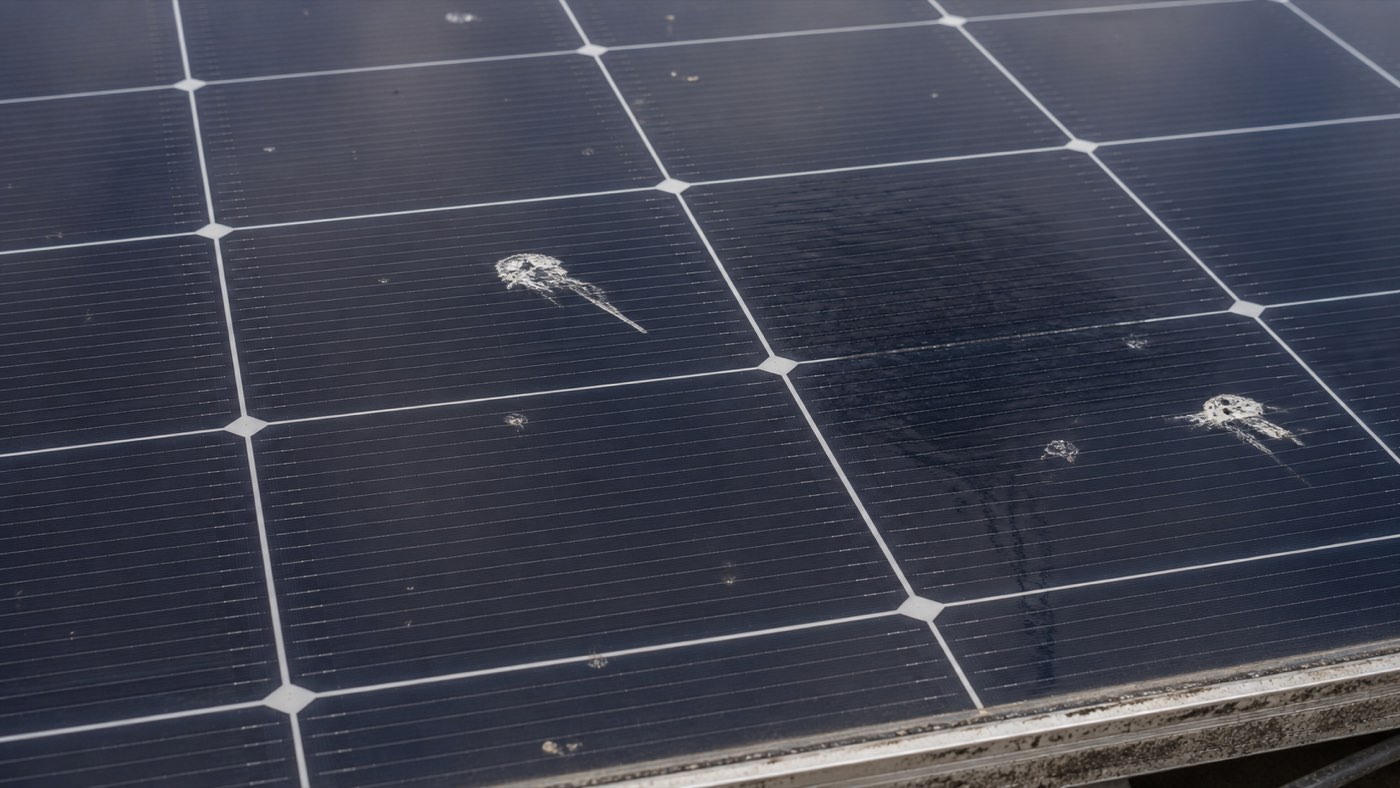
Bird droppings are the most problematic kind of soiling that can affect solar panels. The reason: a bird dropping is completely opaque. The covered cell stops producing electricity, the neighbouring cells turn it into a power consumer, and it heats up locally – creating a hotspot that can damage the cell over time. At the same time, a single blocked cell is enough to drag down the output of the whole string of panels. And the uric acid in the droppings, with a pH of 3 to 5, etches the anti-reflective coating on the glass.
So here is the most important rule up front: with bird droppings, do not wait for the next rainfall – it practically never loosens dried-on crusts. Remove the spot promptly but properly: soften it with plenty of water, loosen it with a soft sponge or soft brush, and never scrape it off dry. This applies to panels you can reach safely from the ground. On the roof, the risk of falling and the DC voltage make this a job for professionals.
Why bird droppings are the worst kind of soiling for solar panels
A grey film of dust settles evenly over the whole system and still lets most of the light through – it costs yield, but only a little in any one place. Bird droppings are different: they land in isolated spots, cover individual cells completely and let no light through there at all. It is precisely this combination of a small area and total shading that makes them so dangerous – bird droppings are considered the most typical cause of hotspots.
Then there is the yield loss: localised deposits such as bird droppings, moss and lichen cost 10 to 20 per cent, well above the damage done by a normal film of dust. For heavily soiled panels in general, Wien Energie puts the loss of output at up to 20 per cent. In Vienna, systems near water, parks and pigeon colonies are particularly affected – as are flat roofs, where birds like to rest.
From bird dropping to hotspot: what happens in the cell
The cells in a panel are connected in series, and the same current flows through all of them. If a dropping covers a cell completely, the cell stops producing electricity – but the other cells keep pushing their current through it. The covered cell becomes reverse-biased, turns from a generator into a consumer and converts the energy of the neighbouring cells into heat. This local overheating is called a hotspot.
The panel’s bypass diodes limit the damage by routing the current around the affected string of cells – but then that whole string drops out, and the panel’s output falls noticeably. If the spot is left for months, there is a risk of lasting consequences: damaged cells, discolouration and, in extreme cases, broken glass. Persistently overheated spots are also among the risk factors for fires – one more reason to take localised shading seriously.
In short: A completely covered cell becomes a heating element inside the panel. The spot is small, but the effect is not – a failed string, cell damage and, in extreme cases, broken glass.
How often do PV systems really catch fire?
To put your mind at rest: very rarely. The multi-year research project by TÜV Rheinland and Fraunhofer ISE on the fire safety of PV systems identified around 210 cases in Germany in which the PV system caused a fire – out of more than 1.5 million systems installed at the time. In 130 of these cases the damage was limited to the system itself; in around 80 cases the building was affected. So there is no reason to panic.
To be honest, though, hotspots are among the avoidable risk factors. Once the system has been fitted, you have hardly any influence over installation quality and components, but the hotspot risk from covered cells can be eliminated with one simple measure – removing bird droppings in good time. It is one of the few areas where looking after the system translates directly into safety, not just yield.
Uric acid: why bird droppings also cause chemical damage
Even if a hotspot never formed, bird droppings would still be a problem. With a pH of 3 to 5, they are distinctly acidic and attack the anti-reflective coating that makes modern solar glass more transparent to light. The longer a spot sits baked onto the glass in the summer heat, the more likely it is to leave a dull shadow in its place – damage that even the most thorough cleaning can no longer undo. So acting quickly protects not only today’s yield but also the coating for decades to come.
Why you should not wait for rain
Rain washes loose dirt such as pollen off steep roofs – but it is no match for bird droppings. Within a few hours, fresh droppings dry into a hard crust that virtually bonds with the glass. At most, the next shower softens its surface before it dries on again. To find out why the self-cleaning effect of rain is generally overestimated, read our article Does rain clean solar panels?.
With bird droppings, time is also a factor: every week the spot is left, the uric acid keeps working away at the coating, and the covered cell remains a potential hotspot. Unlike with a normal film of dust, where you can plan the cleaning at your leisure, it pays to act promptly here.
Removing bird droppings from solar panels: how to do it safely
The most important principle: never scrape them off dry. Scraping dried-on crusts off with a putty knife, a ceramic hob scraper or a hard brush leaves microscratches in the anti-reflective coating – and these permanently reduce the amount of light that gets through there. Here is how to do it properly:
- Soften rather than scrape: Drench the spot with plenty of clear water, ideally low in limescale, and leave it to soak for a few minutes. Dried-on crusts need several passes.
- Loosen gently: Work it loose with a soft sponge, microfibre cloth or soft brush without applying pressure, then rinse with clear water.
- No chemicals, no pressure: Household cleaners and washing-up liquid can attack the coating and seals, and the manufacturers’ instructions rule out pressure washers – we explain why in our article Pressure washers and solar panels.
- Not in the midday heat: Cold water on hot glass risks causing stress cracks. The right time is early in the morning or on a cloudy day.
All of this applies to panels you can reach safely from the ground – on a carport or a plug-in balcony solar kit, for example. As soon as a ladder or the roof comes into play, things change: the risk of falling and the system’s DC voltage make DIY cleaning a real hazard up there. For what you can do yourself and where to draw the line, see our guide Cleaning solar panels yourself.
When to call in a professional – and what to do about the birds themselves
For rooftop systems, larger areas or many spots, professional cleaning is the safe option: we work with pure reverse osmosis water and rotating soft brushes on telescopic poles – crusted droppings are softened and gently loosened, without chemicals, without pressure and without scratches. For family homes up to 10 kWp, the fixed price is 249 euros incl. VAT, including travel within Vienna and the surrounding area.
If birds are constantly sitting on or under your solar panels – in Vienna, they are usually pigeons – cleaning only treats the symptoms. Specialist bird control companies fit nets or spikes around the panels so that the birds do not land or nest there in the first place; that is a separate trade. For systems in exposed locations, a maintenance contract also makes sense: it includes a visual check, priority scheduling and a 10 per cent discount on every clean – so no dropping goes unnoticed for months.
Frequently asked questions
Why are bird droppings so harmful to solar panels?
A bird dropping is completely opaque. The covered cell stops producing electricity, the neighbouring cells turn it into a power consumer, and it heats up locally – creating a hotspot that can damage the cell over time. In addition, the uric acid in the droppings, with a pH of 3 to 5, etches the anti-reflective coating on the glass.
Does rain remove bird droppings from solar panels?
No. Rain washes loose dirt such as pollen off tilted panels, but it practically never loosens dried-on crusts of droppings. The spot often stays stuck for months, and the longer it is left, the longer the uric acid works on the glass coating. With bird droppings, waiting for rain is the wrong strategy.
How do I remove bird droppings from solar panels without damaging them?
Never scrape them off dry – that causes microscratches in the coating. Soften the spot with plenty of clear water, ideally low in limescale, and loosen it with a soft sponge or soft brush. No pressure washer, no household cleaners and no cleaning on hot glass in the midday sun. This applies only to panels that can be reached from the ground – on the roof, the risk of falling and the DC voltage make it a job for professionals.
How often do PV systems catch fire?
Very rarely. The research project by TÜV Rheinland and Fraunhofer ISE identified around 210 fires in Germany caused by PV systems – out of more than 1.5 million installed systems. In 130 of these cases the damage was limited to the system itself. Hotspots from covered cells are one of the risk factors that cleaning in good time can easily eliminate.
Does pigeon proofing help against bird droppings on solar panels?
If you have a persistent pigeon problem, yes: specialist bird control companies fit nets or spikes around the system so that the birds do not land or nest there in the first place. That is a service provided by a separate trade. For the panels themselves, regular checks and gentle cleaning remain the most important protection.
A question about your system?
Tell us the location, size and type of roof — you will get an assessment and a fixed price.