
AI
The short answer: partly. Rain washes coarse, loose dirt such as pollen off tilted panels – at a roof pitch of about 15 degrees or more, this self-cleaning works properly. Rain does not, however, remove fine dust, bird droppings, moss, lichen or the ingrained film of dirt. And on panels mounted at a low tilt of less than 15 degrees, almost everything stays where it is.
The first Europe-wide soiling study by the German Aerospace Center (DLR), CIEMAT and the University of Jaén (2024) shows how wide the gap between theory and practice is: if rain cleaned the panels perfectly, the average annual yield loss in Europe would be just 0.9 per cent. Taking rain’s actual cleaning effect into account, the loss averages 5.3 per cent a year, and up to 14 per cent in some regions. So rain does part of the work – but only part of it.
Cleaning solar panels with rainwater: what works and what does not
Whether a rain shower carries dirt away depends above all on particle size. At around 60 micrometres, pollen is comparatively coarse and sits loosely on the surface – the run-off washes most of it away. Fine dust from traffic, domestic heating and agriculture, at 2 to 10 micrometres, is many times smaller and sticks to the glass so firmly that the thin film of water cannot carry it away. It is precisely these fine particles that build up, over months, into the grey haze that drags down the yield.
Light rain actually makes things worse: drizzle only loosens the dust, spreads it around and then dries, leaving rings and streaks. If this happens repeatedly, the dirt bakes into a crust that even the next heavy downpour can no longer wash off. A typical example is Saharan dust: a heavy thunderstorm usually washes away most of the dust from a single event, whereas several events with drizzle in between leave behind a mineral film.
Rain does not help at all with bird droppings, which cast localised shade and can cause hotspots, or with moss and lichen, which anchor themselves mechanically to the frame and the edge of the glass.
In short: Rain removes coarse, loose deposits from steep roofs. Films of fine dust, crusts, bird droppings and growth remain – no matter how much it rains.
Self-cleaning and roof pitch: the 15-degree threshold
For rainwater to carry dirt away, it has to run off quickly enough. As a rule of thumb, systems with a panel tilt of about 15 degrees or more are largely self-cleaning – Wien Energie also confirms this in its guide. Below that, the balance quickly tips the other way:
- 10 to 15 degrees: The water runs off too slowly to push particles over the lower frame edge. Dirt builds up, and only a weak self-cleaning effect remains.
- 0 to 4 degrees: Rain has practically no cleaning effect left. Water sits in puddles, evaporates and leaves behind mineral spots that the sun bakes on hard.
This affects precisely the types of installation that are common in Vienna and the surrounding area: east-west systems mounted at a low tilt on flat roofs, carport systems and many commercial roofs. If you wait for the rain there, you will wait in vain – such systems need much shorter cleaning intervals than steep house roofs.
The dirt line along the frame edge
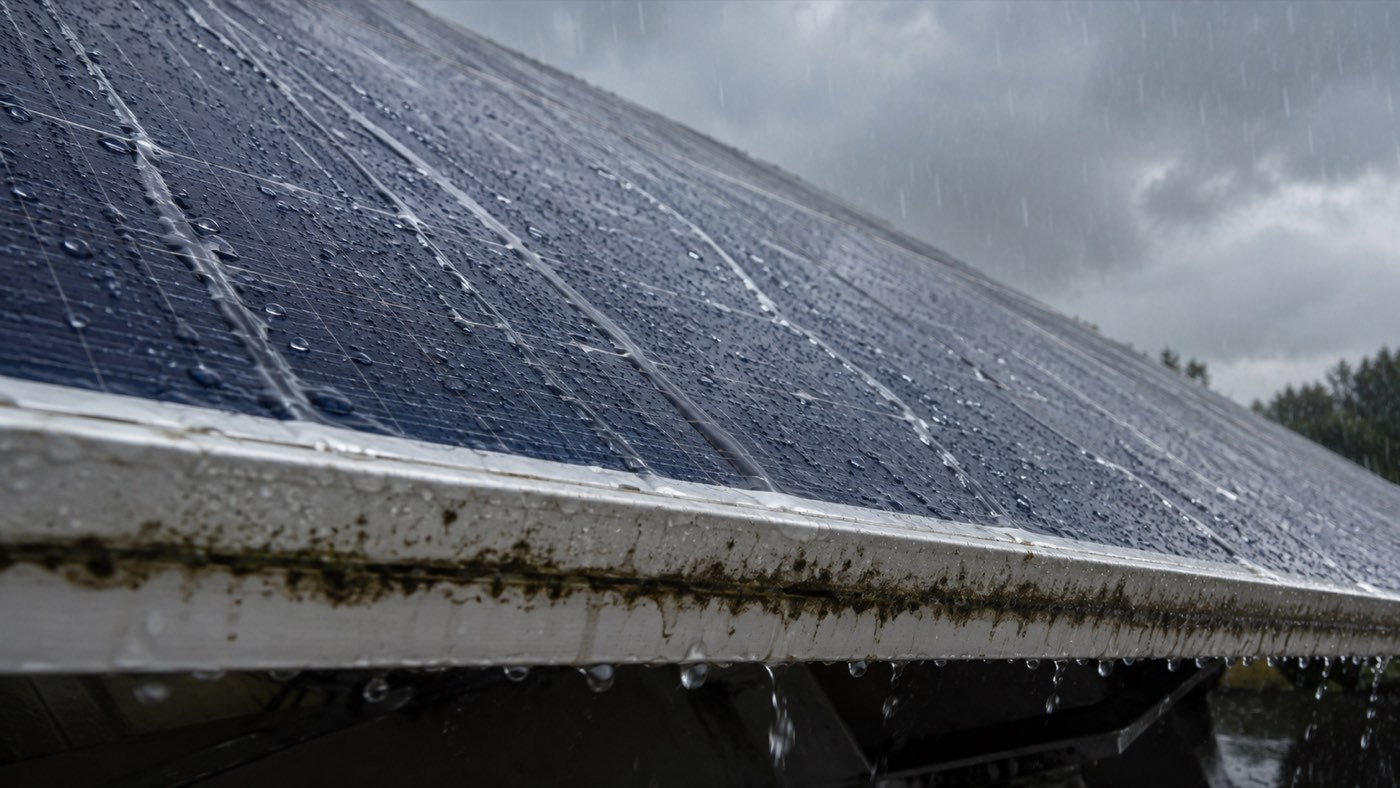
Even on steep roofs, self-cleaning has a weak spot: the lower frame edge. The aluminium frame, only a few millimetres high, holds back the run-off, and suspended particles settle right there. The result is the typical dark stripe along the bottom edge of the panel, a familiar sight on almost every older system.
This dirt line is more than a cosmetic flaw: it permanently shades the bottom row of cells, which in turn holds back the entire row of panels. Over time, algae, moss and lichen also settle in the damp strip of dirt, and no amount of rain will remove them. That is why the frame edge is always part of a professional clean.
Dirty solar panels: how much efficiency is lost
How much soiling reduces output depends on the type of deposit. Real-world figures can be roughly grouped as follows:
| Type of soiling | Typical yield loss |
|---|---|
| Light film of dust and pollen | 2 to 5% |
| Hardened deposits and crusts of dirt | 5 to 10% |
| Bird droppings, moss and lichen (localised) | 10 to 20% |
These ranges are in line with the major studies: Fraunhofer ISE cites a loss of 2 to 7 per cent a year for typical systems, and up to 15 to 25 per cent in industrial and agricultural environments. Long-term measurements by the Bern University of Applied Sciences (Häberlin) in Switzerland, where the climate is closely comparable, found 3.1 to 13.8 per cent depending on the system, with an average of 7.6 per cent. And Wien Energie puts the loss of output from heavily soiled panels at up to 20 per cent.
If rain cleaned perfectly, Europe’s PV systems would lose just 0.9 per cent of their yield a year. In reality, the average is 5.3 per cent.
With localised deposits such as bird droppings, there is a second risk on top of the yield loss: the rest of the panel turns the completely covered cell into a power consumer, and the cell heats up locally. Such hotspots can damage the panel in the long run – one reason not to leave bird droppings until the next rain.
What this means for your system
On a steep house roof in normal surroundings, rain really does take a lot of work off your hands. A professional clean then makes sense as and when needed, typically every few years or when the inverter app shows lower figures than in comparable previous years – you will find the details in our article How often should you clean solar panels? On flat roofs and systems mounted at a low tilt, on the other hand, rain is practically no substitute for cleaning; shorter intervals are the rule there.
We take on exactly the work that rain fails to do: panel by panel with pure reverse osmosis water and rotating soft brushes, including the stubborn frame edges – without chemicals and without high pressure. For family homes up to 10 kWp, we do this at a fixed price of 249 euros incl. VAT, including travel within Vienna and the surrounding area.
Frequently asked questions
Does rain clean solar panels on its own?
Only partly. On roofs with a pitch of around 15 degrees or more, rain washes off coarse, loose dirt such as pollen. Fine dust of 2 to 10 micrometres, bird droppings, moss, lichen and the dirt line along the frame edge stay put – these need manual cleaning.
At what roof pitch does self-cleaning work?
From about 15 degrees. Between 10 and 15 degrees, the water hardly carries any dirt over the lower frame edge, and at 0 to 4 degrees rain has practically no cleaning effect: puddles evaporate and leave behind mineral spots that the sun bakes on.
How much yield does a dirty PV system lose?
Taking the actual effect of rain into account, the Europe-wide 2024 study by the German Aerospace Center (DLR) puts the average loss at 5.3 per cent a year. Fraunhofer ISE gives a typical figure of 2 to 7 per cent, and Wien Energie up to 20 per cent with heavy soiling. Localised deposits such as bird droppings can hold back individual panels even more.
Why does light rain actually make soiling worse?
Drizzle only loosens the dust, spreads it around and then dries, leaving rings and streaks. If this happens repeatedly, the dirt bakes into a solid film that even the next heavy downpour can no longer wash off.
Is a thunderstorm enough after a Saharan dust event?
Often, yes: heavy rain washes away most fresh Saharan dust. If a yellowish film remains visible afterwards, or if there are several dust events in a row with drizzle, a mineral film forms that should be removed professionally.
A question about your system?
Tell us the location, size and type of roof — you will get an assessment and a fixed price.