
AI
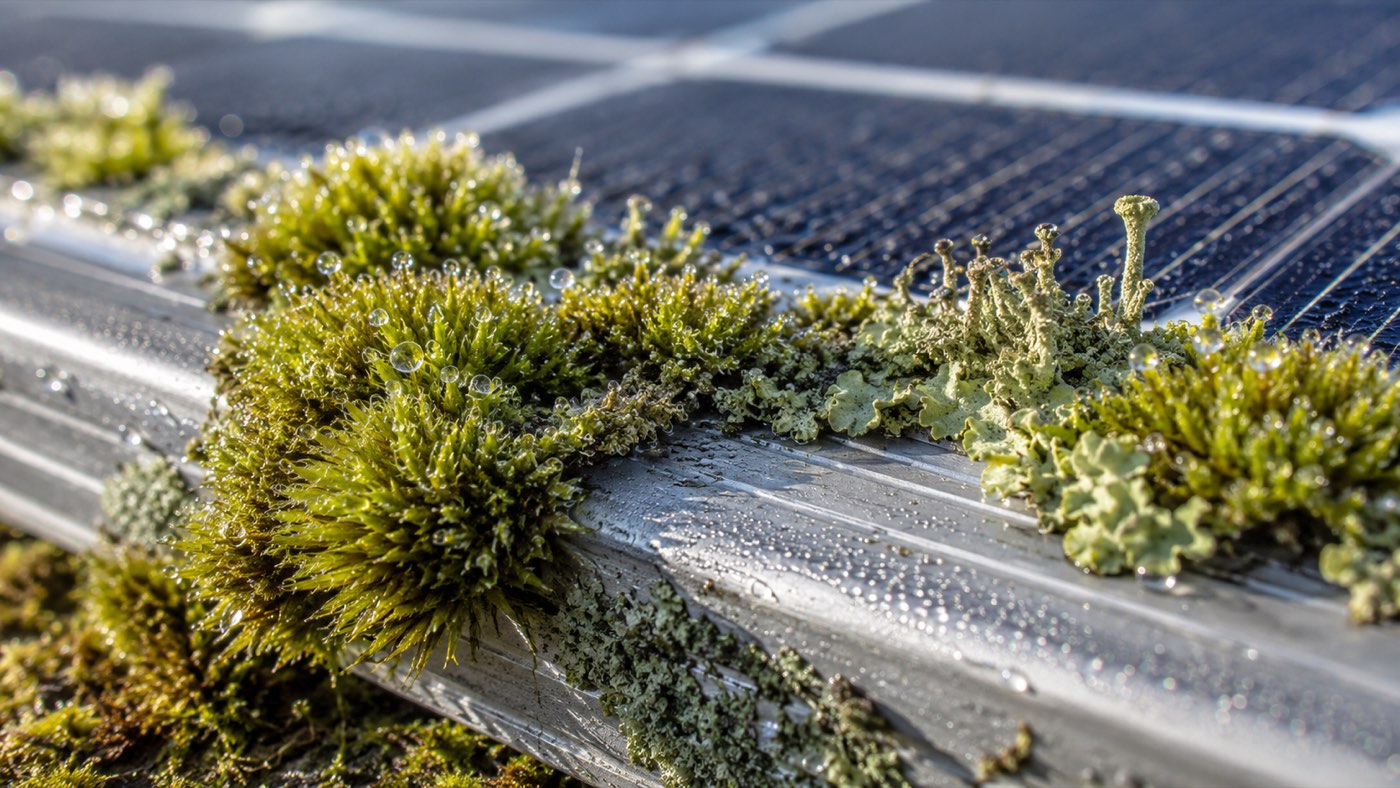
Moss, lichen and algae almost always settle on solar panels in places where water drains away slowly and dirt collects: along the lower frame edge and in the corners. Once established, the growth cannot be rinsed off by rain or with a garden hose – it has to be removed mechanically, with soft rotating brushes and plenty of demineralised water. Scratching, scraping and pressure washing, however, are off limits because they permanently damage the glass and the coating.
Even so, you should take the growth seriously early on: moss and lichen shade the cell edges permanently, not just until the next rain. According to Wien Energie, dirty panels deliver up to 20 per cent less output – and where a cell is completely covered, there is a risk of hotspots, i.e. cells that overheat locally and suffer lasting damage.
Why moss and lichen grow on the frame edge
The aluminium frame of a solar panel rises a few millimetres above the glass surface. At the lower edge, this step forms a small barrier: as rainwater runs off, it briefly pools there, and dust, pollen and fine soil particles get caught. This is how the familiar dirt line forms – a damp, nutrient-rich strip where algae gain a foothold first, followed by mosses and lichens. Lichens are the most stubborn of these inhabitants: they need hardly any nutrients, cling directly to the glass and survive dry spells with ease.
Systems that get little help from rain are particularly affected:
- Panels at a shallow tilt of less than around 15 degrees – on flat roofs and carports, for example: here the self-cleaning effect of rain is almost non-existent, and water and dirt stay put at the edge. More on this in our guide Does rain clean solar panels?
- Shady, damp locations – panels under trees or on north-facing edges take longer to dry off
- Older systems – the longer the dirt line is left undisturbed, the thicker the growth becomes
Permanent shading: the silent yield killer
A cushion of moss acts like a shadow that never moves on. The affected rows of cells at the edge of the panel produce less electricity – and because cells are connected in series, the shaded edge also drags down the output of the cells beyond it. It becomes critical when a cell is completely covered: not only does it stop producing anything, it turns from a producer into a consumer and heats up locally. Over time, such hotspots can cause cell damage and broken glass – the same chain of cause and effect that we describe in our guide Bird droppings on solar panels.
There is also a second, quieter effect: moss holds moisture like a sponge – right against the frame and the seal, which is exactly where the panel should stay dry at all times.
In short: Moss and lichen do not just cost yield – they also trap moisture against the panel and, through hotspots, can pave the way for real damage. The earlier the growth is removed, the easier and cheaper the cleaning.
Why rain does not remove moss
Rain rinses off loose particles – on steep roofs, this works quite well for dust and pollen. But it is no match for established growth: lichens anchor themselves to the glass surface, cushions of moss hold fast in the dirt line, and rain does more to water both than to remove them. Anyone who waits for the problem to “wash away” is in fact watching it grow.
How professionals remove moss and lichen
Done properly, removal is unspectacular but thorough – and, above all, gentle:
- Soaking: Plenty of reverse osmosis water softens the growth and loosens the surrounding film of dirt.
- Mechanical loosening: Rotating soft brushes designed for solar panels work the growth off bit by bit – with patience and several passes rather than more pressure.
- Focus on the edges: The lower frame edge and the corners get special attention, because that is where the growth is most deeply embedded.
- Visual check: Finally, we check the glass, frames and seals – stubborn growth can hide existing damage.
This is exactly how we work at Zelano: with reverse osmosis water, rotating soft brushes and water-fed telescopic poles, following the panel manufacturers’ cleaning instructions. We show the whole process on our How we work page.
Why scratching, scraping and household products are off limits
When the growth is stubborn, it is tempting to reach for a scraper, a wire brush or barbecue cleaner – and that is the most expensive mistake you can make on a solar panel:
- Scrapers and hard brushes leave microscratches in the anti-reflective coating. The result is a permanent yield loss – the coating cannot be repaired.
- Pressure washers can loosen seals and force moisture into the laminate; all panel manufacturers advise against them. You can find out exactly why in our guide Pressure washers and solar panels.
- Chemical moss removers are not approved by the manufacturers, can attack the seals and the coating, and end up in the garden via the gutter.
In their instructions, manufacturers such as Trina and Solarwatt specify how their panels may be cleaned: soft brushes, low-mineral water, no abrasive cleaners. Deviating from these instructions puts the product warranty at risk if anything goes wrong.
Prevention: keep an eye on the edge
We have saved the best news till last: moss and lichen give advance warning. For months before any growth appears, there is a visible dirt line – and that is exactly what cleaning at regular intervals can remove before anything takes hold. Every spring, take a look at the lower panel edges from the ground; for systems at a shallow tilt, an annual check and a cleaning interval of one to two years are advisable, while for steep roofs three to five years is usually enough. You will find guideline values by roof and location in our guide How often should you clean solar panels?
If you would rather not keep track of this in your own calendar, our maintenance contract includes the visual check at every appointment, every clean costs 10 per cent less and we get in touch before the dirt line turns into a habitat.
Frequently asked questions
Does rain remove moss and lichen from solar panels?
No. On steep roofs, rain rinses off loose particles such as dust and pollen, but established growth stays put. Lichens anchor themselves firmly to the glass and the frame edge – they have to be removed mechanically, with soft rotating brushes and plenty of reverse osmosis water. The flatter the system, the less effect rain has anyway.
Can I scrape moss off the panels myself?
We strongly advise against it. Scrapers, putty knives and hard brushes leave microscratches in the anti-reflective coating – a permanent yield loss that no cleaning can undo. Panel manufacturers explicitly rule out such methods in their instructions; in the worst case, you put the warranty at risk. Add to that the risk of falling from the roof and the fact that panels are always live in daylight.
How do I prevent moss and lichen from growing on my solar panels?
By cleaning at regular intervals, before anything takes hold: this removes the dirt line along the lower panel edge, which serves as a breeding ground for moss and lichen. Also take a look at the panel edges from the ground every spring. Systems at a shallow tilt need shorter intervals than steep roofs, because they lack the self-cleaning effect of rain.
A question about your system?
Tell us the location, size and type of roof — you will get an assessment and a fixed price.