
AI
As a rule of thumb, a pitched roof steeper than 15 degrees in a normal residential area gets by with a clean every three to five years. Systems on busy roads, next to fields or near industry need cleaning every one to two years – as do flat-roof and east-west systems tilted at less than 15 degrees, because self-cleaning by rain hardly works there. For agricultural roofs, the German Agricultural Society (DLG) recommends cleaning once or twice a year.
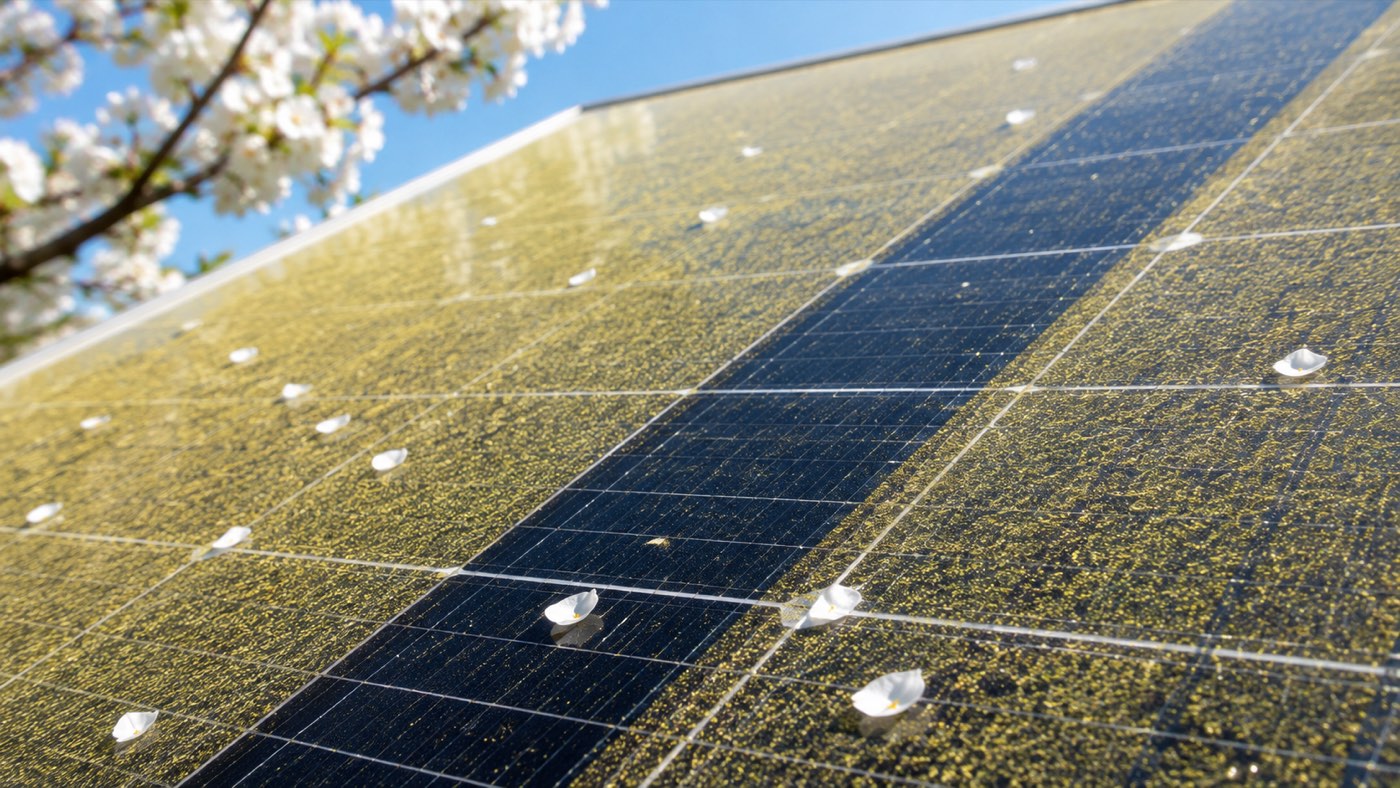
What matters more than any calendar rule, however, is the actual condition of your system: solar panels are cleaned as and when needed. The real triggers are a visible film of dirt, the dark line along the bottom edge of the panel, bird droppings or a drop in yield in the monitoring data. If you stick rigidly to the calendar, you either clean too often and waste money – or too rarely and give away yield: according to Wien Energie, heavily soiled panels deliver up to 20 per cent less output.
How often to clean solar panels? The intervals at a glance
| Scenario | Recommended interval |
|---|---|
| Pitched roof over 15 degrees, normal residential area | every 3 to 5 years, as needed |
| Location on a main road, near industry or next to fields | every 1 to 2 years |
| Flat roof and tilt below 15 degrees (east-west, carport) | every 1 to 2 years, check the frame edges annually |
| Agriculture (livestock buildings, harvest dust, ammonia) | 1 to 2 times a year (DLG recommendation) |
There are two reasons why the ranges are so far apart. First, the roof pitch: from about 15 degrees upwards, rain washes off most coarse, loose dirt such as pollen – below that, almost everything stays put. In a separate article, we explain in detail what self-cleaning by rain can and cannot do. Second, the surroundings: fine dust from traffic, harvest dust from the surrounding area and exhaust air from livestock buildings cause panels to get dirty many times faster than they would on a quiet residential street.
Why clean as needed rather than by the calendar?
The first Europe-wide soiling study by the German Aerospace Center (DLR), CIEMAT and the University of Jaén (2024) shows how widely the rate of soiling varies from system to system: taking the real cleaning effect of rain into account, the average yield loss in Europe is 5.3 per cent a year – but this average masks systems that hardly get dirty and others that lose considerably more. A fixed interval will therefore never suit every system.
Fortunately, it is easy to tell when cleaning is needed: a look at the panels, a look at the monitoring app. Together, the two take only a few minutes and replace any calendar rule.
In short: The interval in the table is a guide – cleaning is due when soiling is visible or a drop in yield is measurable. No earlier, but no later either.
Three signs that cleaning is due
- The yield comparison in the app: If a sunny month produces noticeably less than the same month in previous years and the weather does not account for it, soiling is the most common cause. Further down, we explain how to make the comparison properly.
- The dirt line at the bottom edge: The dark strip along the panel frame permanently shades the bottom row of cells. If it remains there for some time, moss and lichen take hold, and rain can no longer remove them.
- Bird droppings: Localised patches that completely cover individual cells can cause hotspots that damage the panel in the long run. In this case, it is not worth waiting for the next rain or the next scheduled clean.
The best time of year: spring, after the pollen season
The ideal time to clean is late spring, once the worst of the pollen season is over. That way, the highest-yielding months of the year – May to August – begin with clean panels, and the extra yield you gain comes at exactly the time when the sun delivers the most.
In eastern Austria, a second time slot has proved its worth: autumn, after the harvest. Around Vienna, in the Marchfeld and in the Weinviertel, the wind carries fine dust from the fields onto the roofs during the harvest season. For agricultural roofs, DLG Leaflet 414 recommends exactly these two times – after flowering and after the harvest.
Incidentally, cleaning is not done in the blazing midday sun anyway, but in the morning, in the late afternoon or on overcast days – cold water on hot glass risks causing stress cracks and stains. If you would rather not deal with appointments at all, our maintenance contract means we plan your cleaning automatically for the right time slot, with priority scheduling, a 10 per cent discount on every clean and a visual check included.
Monitoring tip: the five-minute yield check
Almost every PV system has a monitoring app these days, and it answers the question of the right interval better than any rule of thumb. Here is how to go about it: compare the yield of as sunny a month as possible with the same month in previous years – June, for example. A deviation of a few per cent is normal weather noise. But if the shortfall persists for several months and gradually grows, there is a good chance that a film of dirt is to blame – in that case, it is worth taking a look at the roof first, followed by professional cleaning; for family homes up to 10 kWp, we charge a flat rate of 249 euros, including travel within Vienna and the surrounding area. In our article “Is solar panel cleaning worth it?” we have worked out whether that pays off.
And what about maintenance? Cleaning is part of it, but no substitute for it: maintenance also includes a regular visual check of the panels, cables and mounting structure, as well as an electrical inspection by a qualified electrical contractor. You can find out what needs doing, how often and what it costs in our guide to solar panel maintenance.
Frequently asked questions
How often should you have solar panels cleaned?
As needed. As a guide: pitched roofs over 15 degrees in a normal residential area every three to five years; systems on busy roads, next to fields or on flat roofs every one to two years; agricultural roofs once or twice a year. The deciding factors are visible soiling and the yield comparison in the monitoring data.
How often does a PV system need maintenance?
An annual visual check of the panels, cables and mounting structure has proved its worth, together with keeping an eye on the monitoring app on an ongoing basis. The electrical inspection should be left to a qualified electrical contractor. With our maintenance contract, the visual check is included at every cleaning appointment.
When is the best time of year for solar panel cleaning?
Spring, after the pollen season – that way, the high-yield summer months begin with clean panels. In eastern Austria, autumn after the harvest is a sensible time for a second clean, because harvest dust from the surrounding area settles on the panels. For agricultural roofs, the German Agricultural Society (DLG) recommends exactly these two times.
Can cleaning too often damage the panels?
Not with the right method – rotating soft brushes and demineralised reverse osmosis water. Damage is caused by the wrong tools, such as pressure washers, hard brushes or abrasive cleaners, not by how often you clean. Cleaning too often does waste money, however, which is why we recommend cleaning as needed.
- Wien Energie: Cleaning solar panels – how to keep your system efficient (in German)
- DLG Leaflet 414: Cleaning solar panels on livestock buildings (in German)
- pv magazine: Europe’s first PV soiling study (DLR/CIEMAT/University of Jaén, 2024)
- German Aerospace Center (DLR): Soiling losses in Europe (Renewable Energy, 2024)
A question about your system?
Tell us the location, size and type of roof — you will get an assessment and a fixed price.