
AI
Maintaining a PV system involves three components: scheduled cleaning of the panels, a visual check of the glass, frames and mounting structure, and an electrical inspection by a qualified electrical contractor. For private operators in Austria, there is no legal maintenance requirement – but insurance terms, manufacturers’ warranties and, for commercial systems, operator responsibility make regular upkeep effectively mandatory.
When it comes to costs, a rule of thumb helps: the total running costs of a PV system are usually 1 to 2 per cent of the investment cost per year – this covers not only maintenance but also insurance, meter charges and reserves. Depending on the interval, our price for the predictable core of maintenance (cleaning with a visual check) is typically 50 to 250 euros per year for a family home. In this guide, we openly show how those figures break down.
What does solar panel maintenance involve?
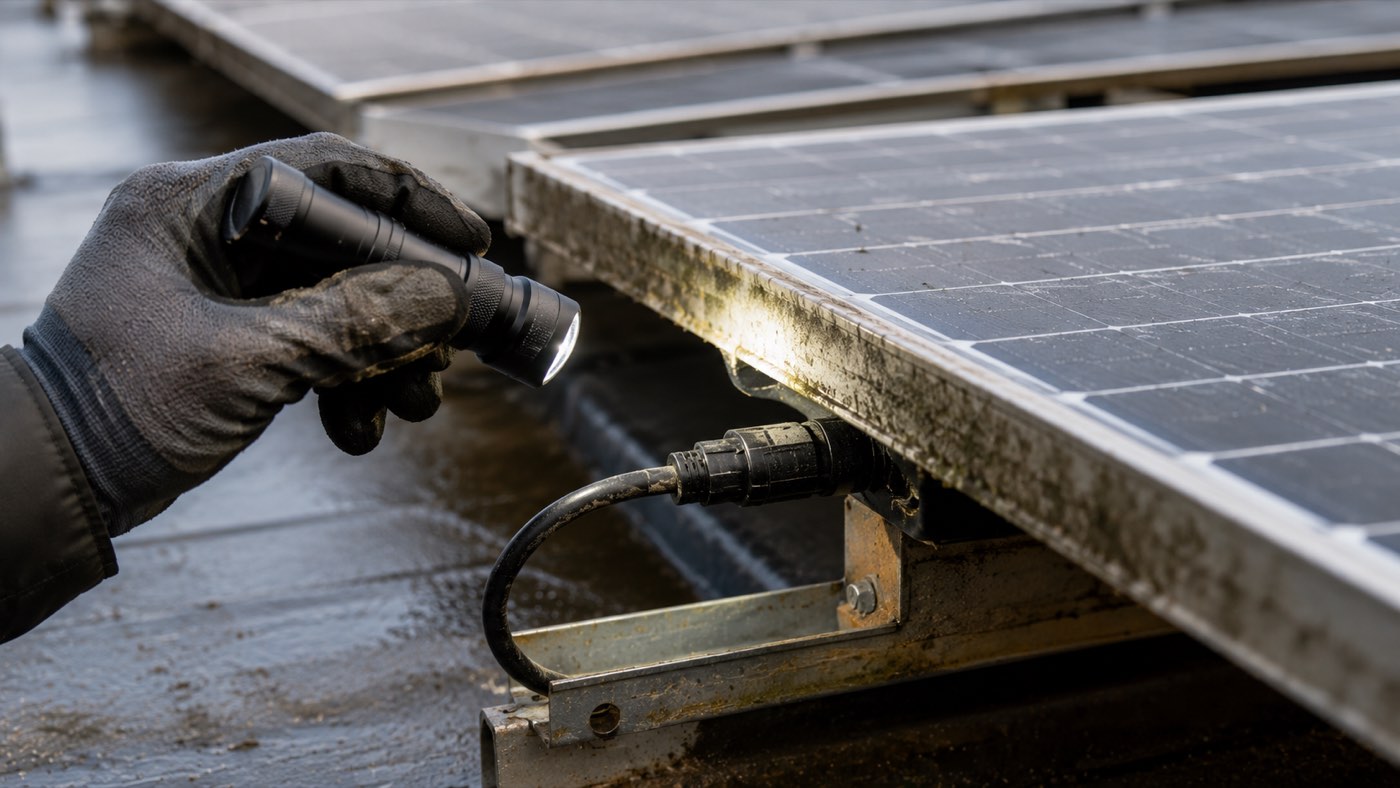
“Maintenance” conjures up toolboxes and switchgear – in reality, most of the upkeep of a PV system is unspectacular: looking, cleaning, keeping records. Organised sensibly, PV system maintenance looks like this:
| Component | Who does it? | How often? |
|---|---|---|
| Cleaning the panels | A specialist company like us – with reverse osmosis water and rotating soft brushes | Depending on the location, every 1–2 years (flat roof, agricultural area, close to roads) or every 3–5 years (standard pitched roof) |
| Visual check | The specialist company at the cleaning appointment; in between, you do it yourself from the ground | At every appointment, and also after storms or hail |
| Electrical inspection | Only a qualified electrical contractor | Every few years; the contractor decides the details |
Why does cleaning come first? Because it is the part of maintenance that directly determines the yield: according to Wien Energie, dirty panels deliver up to 20 per cent less output, and concentrated soiling such as bird droppings creates a risk of hotspots – locally overheated cells that can permanently damage the panel. You can see in detail how our cleaning works on our How we work page.
Then there is the one component that costs nothing: yield monitoring. If you compare the yields in your inverter app once a month with the same months in previous years, you will spot gradual losses before they become costly. This is the simplest form of upkeep – and it is entirely up to you.
Distinction: Maintaining solar thermal systems (hot water) is a different trade. That work involves antifreeze, system pressure and heat exchangers – a job for your plumbing and heating installer. This guide and our services cover solar PV.
Is solar panel maintenance mandatory?
The honest answer: for private operators, there is no legal maintenance requirement. Nobody checks whether you ever have your panels cleaned. But there are three reasons to treat maintenance as if it were mandatory anyway:
- Policyholder obligations: Many solar panel and loss-of-yield insurance policies require the system to be properly maintained. If damage can be traced back to neglected maintenance – for example, consequential damage from a hotspot caused by bird droppings left in place for years – the insurer can reduce the payout. We have broken down exactly what these clauses say in our guide Solar panel insurance and policyholder obligations.
- Manufacturer’s warranty: Panel manufacturers specify in their instructions how the panels may be cleaned and handled – for example, no pressure washers and no aggressive cleaning agents. Being able to prove that the panels have been handled professionally strengthens your position if you make a warranty claim.
- Operator’s duty in commercial settings: Anyone who operates a system commercially is responsible for its safe operation. After a claim, a complete maintenance history is the evidence that you have met this responsibility. For businesses, maintenance is therefore effectively mandatory – find out more on our Commercial & industrial page.
Maintenance costs: what does solar panel maintenance cost per year?
The common rule of thumb for total running costs – maintenance, insurance, meter, reserves – is 1 to 2 per cent of the original investment cost per year. The specialist website Echtsolar gives an average of around 222 euros a year in running costs for a 10 kWp system without battery storage. This figure is a guide, not a calculation: how much you actually spend depends mainly on the cleaning interval and on what your insurance costs.
The part of maintenance that we take on is priced transparently:
- Family home up to 10 kWp: fixed price of 249 euros incl. VAT per clean, including travel within Vienna and the surrounding area. Under the maintenance contract, the price of each clean is reduced by 10 per cent to 224.10 euros.
- Systems from 10 to 30 kWp: 2.90 euros per panel incl. VAT, minimum charge 249 euros.
- Commercial systems: individual quote after a free on-site visit.
For a family home – depending on whether the panels are cleaned every year, every two years or every four to five years – this typically averages out at 50 to 250 euros in maintenance costs per year. If you think in terms of maintenance costs per kWp: for a system that uses the full 10 kWp, our fixed price works out at around 25 euros per kWp per clean; for smaller systems, the figure per kWp is higher, because travel and safety measures stay the same. You will find all prices in detail on our solar panel cleaning prices page.
On top of this, there is a separate electrical inspection by a qualified electrical contractor every few years. We deliberately do not quote a price for it – it depends on the system and the contractor and is not a service we provide.
Does a maintenance contract make sense – and do you need a template?
A maintenance contract makes sense whenever cleaning at regular intervals is a given anyway: for flat-roof and east-west systems (below a tilt of around 15 degrees, rain does practically nothing to help with cleaning), for commercial and agricultural roofs and wherever a complete maintenance history matters to insurers or management. For a family home with a steep roof, it is mainly a matter of convenience: set it up once and never think about appointments again.
Anyone searching for “maintenance contract template” usually wants to know what such a contract should contain. Check any contract against these points:
- Interval: suited to the roof and location, not rigidly tied to the calendar
- Scope of work: What is included – only cleaning, or a visual check as well?
- Price advantage: A subscription should cost less than individual bookings
- Records: There must be a written record of every job
- Cancellation: no long minimum terms
Our maintenance contract is structured in exactly this way: 10 per cent off every clean, priority scheduling in the spring season, a visual check included at every appointment, and it can be cancelled at any time.
Checklist: how to stay on top of maintenance
- Monthly: compare the yield in your inverter app with the same months in previous years
- After storms, hail or Saharan dust: visual check from the ground – broken glass, shifted panels, a yellowish film
- In spring: check the panel edges for dirt lines, moss and lichen – that is where soiling builds up first
- If you spot bird droppings: have them removed promptly rather than waiting for rain – concentrated soiling is the most common cause of hotspots
- Cleaning as needed: book a clean when soiling is visible or your monitoring shows a drop – guideline values in our guide How often should you clean solar panels?
- Every few years: arrange an electrical inspection with a qualified electrical contractor
- Always: keep a record of every job – as proof for the insurer and the manufacturer
On the last point: a maintenance log does not have to be a form. What matters is that the date, the company carrying out the work, the scope of the work and anything unusual that was found are recorded – ideally with photos. Our invoices document every job; over the years, this automatically builds up a maintenance history that can be worth real money in the event of a claim.
Frequently asked questions
Is there a legal maintenance requirement for private PV systems?
No, there is no law in Austria that requires private operators to maintain their PV system. Even so, upkeep becomes effectively mandatory: many solar panel insurance policies require it as part of their policyholder obligations, and panel manufacturers make their warranty conditional on professional handling. In addition, commercial operators are responsible for the safe operation of their system.
How much should I budget per year for solar panel maintenance?
As a rule of thumb, the total running costs of a PV system come to 1 to 2 per cent of the investment cost per year – this covers not only maintenance but also insurance, meter charges and reserves. Depending on the interval, our price for the predictable core of maintenance (cleaning with a visual check) is typically 50 to 250 euros per year for a family home. On top of this, there is a separate electrical inspection by a qualified electrical contractor every few years.
What goes into a maintenance log?
The date, the company carrying out the work, the scope of the work (for example, cleaning and a visual check), anything unusual that was found and ideally photos of the condition of the system. These records prove to your insurer and the manufacturer that the system has been properly maintained. Our invoices document every job – over the years, this builds up into a complete maintenance history.
Who maintains solar thermal systems?
The plumbing and heating installer. Solar thermal systems (hot water) involve antifreeze, system pressure and heat exchangers – that is plumbing and heating work and a different trade from solar PV. We specialise in PV systems and take care of their cleaning and visual checks.
How can I tell when maintenance is due?
There are two signs: visible soiling (a grey film, a dirt line along the lower edge of the panel, bird droppings, moss) or a shortfall in yield, shown by your monitoring, that cannot be explained by the weather. To check, compare the yields in your inverter app with the same months in previous years.
A question about your system?
Tell us the location, size and type of roof — you will get an assessment and a fixed price.