
Saharan dust on solar panels: clean straight away or wait and see?
The sky is yellow, the panels are dusty – and the phones at some cleaning companies are ringing off the hook. We explain how much yield Saharan dust really costs and when cleaning is actually worth it.
AI
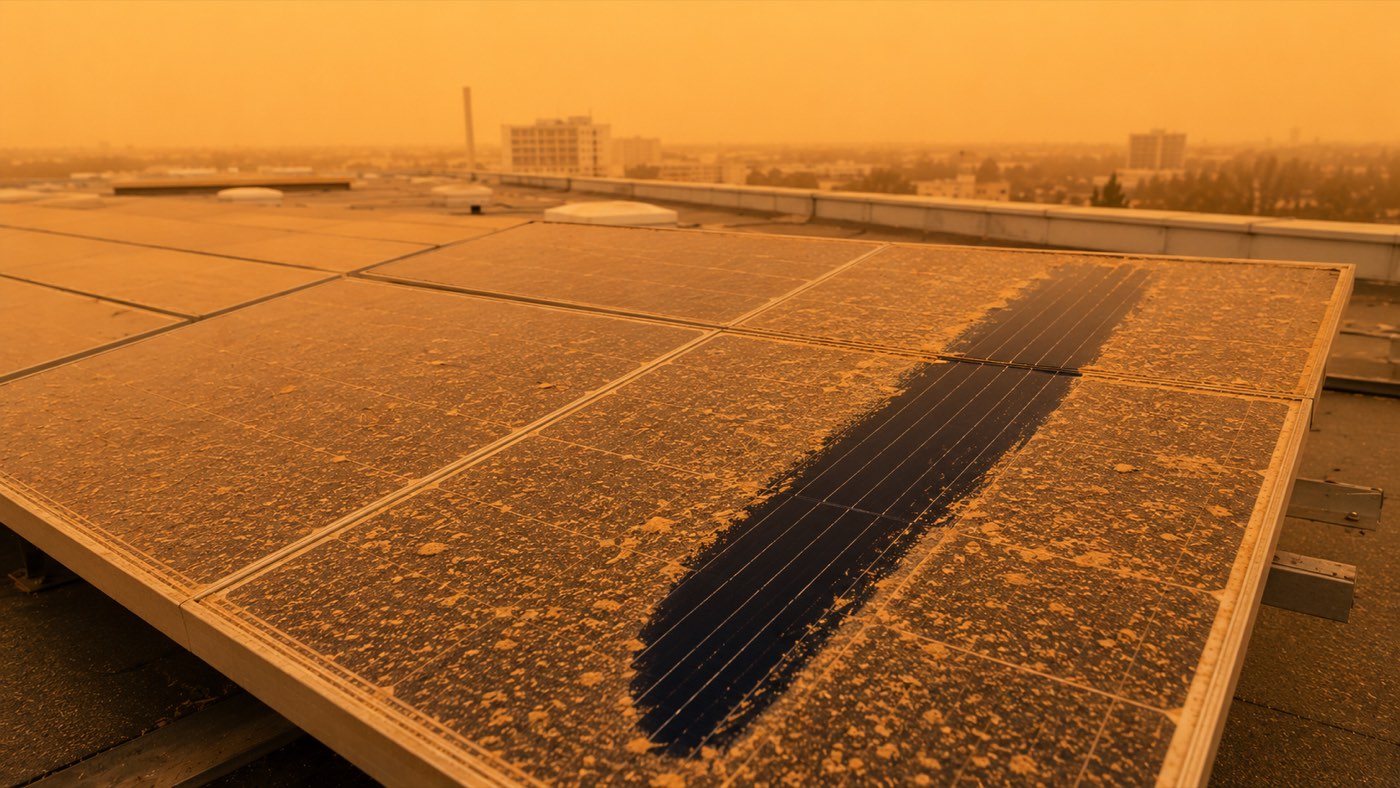
The short answer: in most cases, you can wait and see. That is because most of the yield loss occurs during the Saharan dust event – it is caused by the hazy atmosphere, which lets less sunlight through to your panels. The PerduS research project by the German Meteorological Service (DWD), the Karlsruhe Institute of Technology (KIT) and meteocontrol puts this effect at 10 to 20 per cent less PV output. No amount of cleaning in the world will help with that, because the dust hangs in the air, not on the glass.
The deposit on the panels themselves matters much less: after the striking event in March 2022, which also turned Austria orange, the operator Pfalzsolar estimated the yield loss caused by the deposited sand particles at less than 0.5 per cent – and the next heavy rain washed most of it off anyway. So our rule of thumb is: wait for the next proper rainfall. If a yellowish film remains visible on the panels afterwards, the dust has stuck fast – and then cleaning is worth it.
What Saharan dust does to solar panels
Several times a year, southerly air currents carry fine mineral dust from the Sahara all the way to Central Europe – in eastern Austria mostly in spring, when the sky turns milky yellow and cars are coated in a beige film overnight. Such an event affects your PV system in two ways that should be clearly distinguished:
| Effect | When | Impact |
|---|---|---|
| Atmospheric haze | During the event | 10 to 20% less output – cleaning has no effect |
| Fresh dust deposit | Days afterwards | Minor, often below 1% – rain washes most of it off |
| Hardened mineral film | After several events with drizzle | Persistent yellowish film that rain no longer removes |
The third point is the really tricky one – and the reason why the topic deserves more attention than the spectacular pictures of the yellow sky: what counts is not the individual event, but the sum of them all.
Why we do not recommend immediate cleaning across the board
After every major dust event, promotions circulate urging immediate cleaning. We do not consider this a reputable practice. While the event is still going on, cleaning achieves nothing – the haze is in the atmosphere, and fresh dust immediately settles back on the wet panels. And the fresh, loose layer afterwards is simply not an emergency on a normal pitched roof: in 2022, Pfalzsolar found no measurable decline in the performance ratio across more than 300 megawatts of monitored system capacity.
In short: Cleaning during the event is pointless, and straight afterwards it is usually unnecessary. The deciding factor is what remains on the glass after the next heavy rain.
Heavy, prolonged rain rinses most of the fresh Saharan dust off sloping roofs. How well this self-cleaning works, however, depends heavily on the roof pitch: from about 15 degrees, the water runs off quickly enough; below that, the dust largely stays where it is. Flat-roof systems and east-west systems mounted at a low tilt therefore hardly benefit from rain – for them, the situation is different from the outset.
When Saharan dust does become a problem
Saharan dust is mineral dust with a very fine grain size. That is exactly what makes it a nuisance in the long term: the particles are so small that simple rinsing does not reliably remove them – even the operator admitted as much in pv magazine. If, instead of a heavy thunderstorm, there is only drizzle – so-called “blood rain”, familiar from the spots it leaves on cars – the dust is partly dissolved and spread around, and then dries into yellowish rings and streaks. If this pattern repeats over several events, the dust bakes into a mineral film that acts like a permanent grey veil and even survives torrential rain.
What is more, the events are becoming more frequent. A study published in 2026 and coordinated by the Paul Scherrer Institute (PSI) shows that the concentration of desert dust over Central and Northern Europe increased by 10 to 25 per cent during the study period – and has more than doubled over the last 150 years. So if you run a PV system in Vienna, Lower Austria or Burgenland, you are likely to have to deal with this issue on your roof more often, not less.
Three situations in which you should take Saharan dust seriously:
- Several events in a row with little or only light rain in between – typical of dry springs.
- Flat roof or a pitch below 15 degrees: There is no self-cleaning here; the dust collects along the frame edge and around the edges of puddles.
- An existing film of dirt: Mineral dust sticks better to soot, pollen and old deposits and intensifies the film that is already there.
The simple decision rule
You need neither measuring instruments nor a remote expert assessment for this – just the next heavy rain and an honest look:
- Wait and see: Let the event and the next proper downpour pass.
- Take a look: Does a yellowish film remain on the panels, or are dirt lines still visible along the lower frame edge?
- Check the figures: In the inverter app, compare clear, sunny days with similar days before the event or from the previous year. If the yield is noticeably lower, something has stuck fast.
If point 2 or 3 applies, cleaning makes sense – not as a panic reaction, but as normal upkeep. You can see how the numbers work out in our article Is solar panel cleaning worth it?.
When cleaning is needed: gently, not with high pressure
Mineral dust that has stuck fast tempts people into two mistakes that practically all panel manufacturers warn against: using a pressure washer, whose jet can damage the glass and seals and cost you your warranty, and dry rubbing, which drags the hard particles across the glass surface like sandpaper. Hard tap water is no solution either – as it dries, it leaves a limescale film and so merely replaces one film with another.
That is why we work with pure reverse osmosis water and rotating soft brushes on telescopic poles, panel by panel and including the frame edges where the dust collects – see how we work. For family homes up to 10 kWp, our fixed price of 249 euros incl. VAT applies, including travel within Vienna and the surrounding area. If your panels are mounted close to the ground, you can also use a soft brush and water that is low in limescale to clean them yourself – but you should not climb onto the roof to do so.
Frequently asked questions
Do I need to have my solar panels cleaned after every Saharan dust event?
No. The biggest loss is caused by the hazy atmosphere during the event – no cleaning can help with that. On sloping roofs, the next heavy rain usually washes most of the fresh deposit off. Cleaning only makes sense if a yellowish film remains visible afterwards or if there are several dust events in a row.
How much output does Saharan dust really cost?
During the event, the atmospheric haze reduces PV output by 10 to 20 per cent, according to the PerduS research project by the German Meteorological Service (DWD), the Karlsruhe Institute of Technology (KIT) and meteocontrol. The deposit itself has a much weaker effect: after the major event in March 2022, the operator Pfalzsolar estimated the yield loss caused by the sand particles at less than 0.5 per cent. It is only the hardened mineral film left by repeated events that becomes a problem.
Does rain wash Saharan dust away?
Heavy, prolonged rain rinses most of the fresh, loose Saharan dust off roofs with a pitch of about 15 degrees or more. Drizzle, on the other hand, makes things worse: it spreads the dust and dries to leave yellowish rings. On flat roofs and on systems mounted at a low tilt of under 15 degrees, hardly any self-cleaning takes place.
How can I tell whether cleaning after Saharan dust makes sense?
Wait for the next heavy rain and then check two things: does a yellowish film remain on the panels, or are dirt lines still visible? And is the yield on clear days still below comparable values in your monitoring? If either applies, professional cleaning is worth it.
- KIT / DWD / meteocontrol, PerduS project: Saharan dust – reliable output forecasts for photovoltaics (via Sonnenseite) (in German)
- pv magazine Germany (29 March 2022): Saharan sand reduces PV system yields only briefly and slightly (in German)
- pv magazine Germany (16 July 2026): Increasing desert dust impairs PV yields in Europe (PSI study) (in German)
A question about your system?
Tell us the location, size and type of roof — you will get an assessment and a fixed price.