
AI
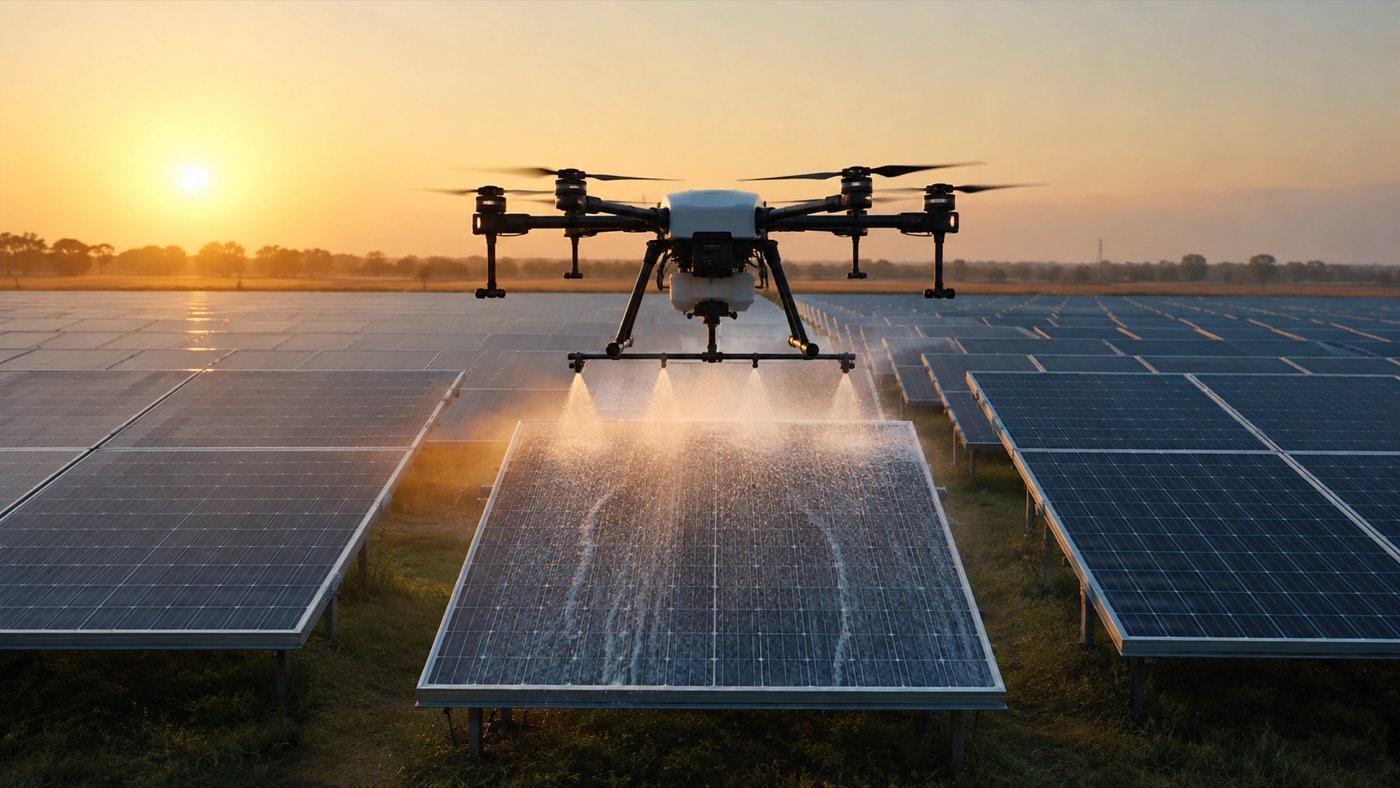
Solar panel cleaning with drones means that a spray drone flies over the panel surfaces and applies demineralised water, usually without touching them – either from a tank carried on board or through a hose from a ground station. One Austrian provider states that this typically costs 4 to 15 euros per square metre; conventional brush cleaning in eastern Austria costs about 2.50 to 3.50 euros per square metre.
The technology can make sense in places that people find hard to get to: high facades, steep glass roofs, large areas that are difficult to access without scaffolding or a lifting platform. As things stand today, however, cleaning solar panels with drones is expensive hype for the typical family home: the price per square metre is higher, there is no brush contact, and the regulatory burden is considerable. Mechanical cleaning with rotating soft brushes and reverse osmosis water remains the standard – in this article we show why, point by point.
How does cleaning solar panels with drones work?
Cleaning drones are not toys but robust hexacopters or octocopters that often weigh more than 25 kg at take-off. Two types of system have become established on the market:
- Spray drones with a tank: The drone carries the water itself – a tank capacity of around 40 litres is typical. Its technology comes from agriculture (crop-spraying drones), and it sprays the cleaning medium onto the surface through rotating nozzles without touching it. According to manufacturer figures, prices for such units start at around 17,600 euros excl. VAT; when fully loaded, the flight time is about 10 to 15 minutes per battery.
- Cable-connected drones (tethered systems): A combined cable connects the drone to a ground station and carries power and water up to it – so the flight time is, in theory, unlimited. Cleaning is done at low pressure, sometimes with hot or demineralised water; the range is limited by the length of the hose or cable.
The provider market in Germany, Austria and Switzerland is young but growing: in Germany, several service providers advertise drone cleaning for facades and solar panels; in Switzerland, the manufacturer WINDRON sells cleaning drones complete with a ground station; and in Austria, for example, Glanzdrohne from Upper Austria offers drone cleaning. Almost all systems have one thing in common: the drone sprays – as a rule, it has no brush that moves mechanically across the panel.
Solar panel cleaning with drones: costs compared
To put the prices into perspective, it is worth taking a sober look at the published figures. The Austrian provider Glanzdrohne states that drone cleaning typically costs 4 to 15 euros per square metre; complex projects are charged by the hour or at a flat rate. The Swiss manufacturer WINDRON puts operating costs for service providers at around CHF 2 per square metre and recommends selling prices of CHF 3 to 8 per square metre. For comparison: conventional solar panel cleaning with water and a brush is offered in Vienna and the surrounding area from about 2.50 euros per square metre.
| Method | Typical price range | Suitable for |
|---|---|---|
| Drone cleaning (service provider, AT) | approx. €4–€15/m² | Large hard-to-access areas, facades, glass roofs |
| Drone cleaning (CH, manufacturer’s recommendation) | approx. CHF 3–8/m² | As above |
| Manual soft-brush cleaning | approx. €2.50–€3.50/m² | All common rooftop systems |
| Zelano fixed price, family home | €249 incl. VAT up to 10 kWp | House roofs in Vienna & the surrounding area, incl. travel |
| Buying a spray drone | from approx. €17,600 excl. VAT | Service providers, not private users |
For a house roof with 25 to 50 m² of panel area, that would mean: even at the lower end of drone prices, you would pay more than for a thorough mechanical clean – and at the upper end, many times as much. For a detailed breakdown of what conventional cleaning costs, see our guide Solar panel cleaning: costs; you will find Zelano’s prices set out transparently on our solar panel cleaning prices page.
Where drone cleaning can really make sense
To be fair, the technology does have genuine applications. The key argument in its favour is accessibility – the drone needs no scaffolding, no lifting platform and no one on a rope. This can pay off for:
- tall or awkwardly shaped buildings where scaffolding or a cherry picker would cost more than using the drone,
- steep glass and in-roof systems that cannot be reached safely from either the ground or the roof,
- large continuous areas with loose dirt such as dust or pollen, where contact-free spraying is enough,
- jobs where occupational safety is a priority: nobody has to go up on the roof, and the risk of falling is eliminated entirely.
In this niche, however, the drone does not compete with the telescopic pole but with lifting platforms and rope access technicians – and, on large systems, with solar panel cleaning robots, which provide the brush contact that the drone usually lacks.
The limits: water weight, no brush, wind and regulations
Water is heavy. One litre weighs one kilogram. A tank drone with 40 litres on board is empty after a few minutes and has to keep landing, refilling and changing batteries – so the area it actually covers per hour falls far short of the brochure figures. Cable-connected systems solve this problem, but at the cost of hose weight, limited range and complex ground logistics.
There is no brush contact. This is the crucial point for cleaning quality. Contact-free spraying removes loose dust and pollen – in other words, exactly the kind of dirt that, on pitched roofs, is to some extent already taken care of by the rain. Baked-on dirt lines along the frame edge, bird droppings, moss and lichen, on the other hand, need gentle mechanical action: soft rotating brushes with limescale-free water. Panel manufacturers such as Trina or Solarwatt specify exactly this gentle method in their instructions – and prohibit high pressure and aggressive cleaning agents. Some drone providers rely on cleaning chemicals to compensate; with solar panels, this is a delicate matter, because agents that have not been approved can attack the anti-reflective coating and seals and jeopardise the manufacturer’s warranty.
Wind and weather. According to providers, cleaning drones only operate in winds of up to about 30 to 35 km/h – above that, flying becomes unsafe and the spray mist uncontrollable. A job therefore needs a weather window, which cannot always be planned for in Vienna.
Regulations and permits. With a take-off weight of over 25 kg, cleaning drones fall into what is known as the “specific” category under EU drone regulations: in Austria, the operator needs authorisation from Austro Control for this, as well as pilots with documented training. Getting approval for flights over densely built-up areas – that is, over Vienna’s residential neighbourhoods with adjoining properties – is correspondingly complex. For the service provider, this is a predictable overhead; for ad hoc jobs on a house roof, it is another cost driver.
The drone replaces the scaffolding, not the brush. Where loose dust is the problem, it can help – where stubborn dirt costs yield, it reaches its limits.
Our honest verdict: yes for the niche, no for the house roof
Drone cleaning is a new, specialised tool for hard-to-access areas – nothing more, nothing less. As things stand today, three facts count against it for the typical family home in Vienna and the surrounding area: it is more expensive per square metre, it is less effective on stubborn dirt, and its main advantage – accessibility – is irrelevant on a normal house roof, because telescopic poles can reach every panel from the ground or from a secured area of the roof.
Zelano does not offer drone cleaning – this article is a purely informational assessment. We clean with rotating soft brushes, reverse osmosis water and telescopic poles, panel by panel and with a visual check for dirt lines, bird droppings and visible damage. You can see exactly how a job is carried out on our How we work page.
In short: At Zelano, thorough solar panel cleaning for family homes costs a fixed price of 249 euros incl. VAT for up to 10 kWp, including travel within Vienna and the surrounding area. For commercial and large systems, we prepare an individual quote after a free on-site visit – and tell you honestly whether your panel area needs specialised technology at all.
Frequently asked questions
How much does solar panel cleaning with drones cost?
One Austrian provider states that drone cleaning typically costs 4 to 15 euros per square metre, depending on the degree of soiling and the effort involved; complex projects are charged by the hour or at a flat rate. A Swiss drone manufacturer recommends that service providers charge CHF 3 to 8 per square metre. Conventional brush cleaning in eastern Austria, by contrast, costs about 2.50 to 3.50 euros per square metre – at Zelano, the fixed price for a family home with up to 10 kWp is 249 euros incl. VAT and travel within Vienna and the surrounding area.
How does cleaning solar panels with drones work?
Two systems are common: spray drones with their own tank (about 40 litres, around 10 to 15 minutes of flight time per battery) and cable-connected drones that draw water and power through a line from a ground station. Cleaning is usually contact-free, with demineralised water at low pressure – the drone sprays the surface down, and as a rule no brush touches the panels.
Does a cleaning drone make sense for a family home?
As things stand today, no. Drone cleaning costs significantly more per square metre than the conventional method, and contact-free spraying is worse than a rotating soft brush at removing baked-on dirt lines, bird droppings and lichen. Typical house roofs are easy to reach with telescopic poles from the ground or from the roof – the drone’s real advantage, coping with difficult access, is irrelevant there.
Is just anyone allowed to fly a cleaning drone?
No. Cleaning drones are usually hexacopters or octocopters with a take-off weight of over 25 kg, which means that under EU drone regulations they fall into what is known as the “specific” category. In Austria, the operator needs authorisation from Austro Control for this, as well as suitably trained pilots; weather windows are also needed, because flying stops at wind speeds above about 30 to 35 km/h.
Does Zelano clean solar panels with drones?
No. Zelano cleans with rotating soft brushes, reverse osmosis water and telescopic poles – panel by panel, with a visual check. This article is a purely informational assessment of drone technology. As things stand today, mechanical soft-brush cleaning is the more thorough and less expensive method for rooftop systems in Vienna and the surrounding area.
- Glanzdrohne (AT) – How drone cleaning works: technology, process & limits (in German)
- WINDRON (CH) – Cleaning drone: system, operating costs and recommended prices (in German)
- CopterClean (DE) – Cleaning drone: technical data and purchase price (in German)
- Wien Energie – Cleaning solar panels: how to keep your system efficient (in German)
A question about your system?
Tell us the location, size and type of roof — you will get an assessment and a fixed price.