
AI
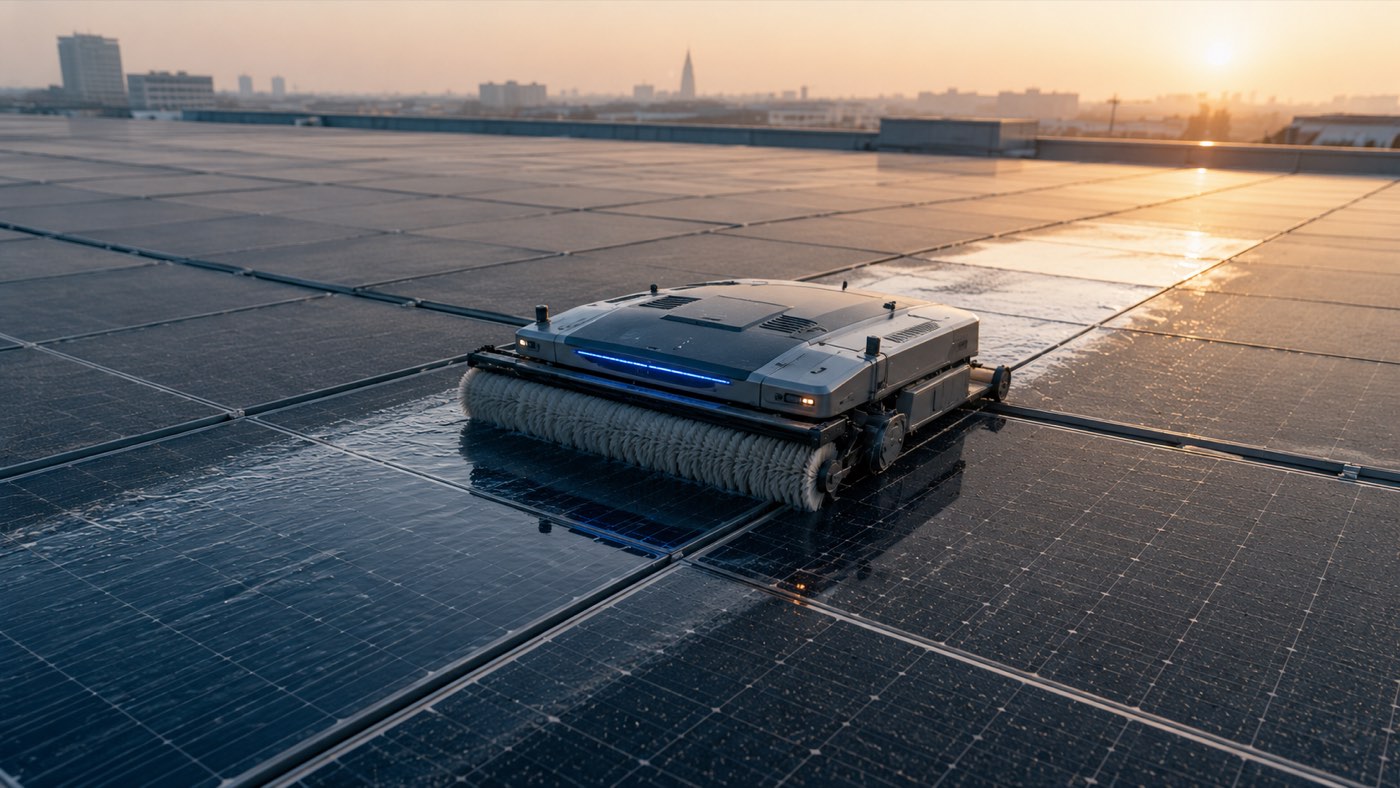
Solar panel cleaning robots are remote-controlled or semi-autonomous machines that work their way across the panel surfaces with rotating brushes and demineralised water. Professional-class machines start at around 19,900 euros to buy; the daily rental rate is about 490 euros – and rental companies explicitly target commercial users with contiguous panel areas of 200 m² or more.
For large flat roofs, ground-mounted systems and farm buildings, the technology makes sense. For a family home with 25 to 50 m² of panel area, it is out of all proportion: even a single day’s rental costs more than a complete professional solar panel clean – at Zelano, a fixed price of 249 euros incl. VAT up to 10 kWp, including travel within Vienna and the surrounding area.
Which cleaning robots are available for solar panels?
The term “cleaning robot for solar panels” covers very different classes of equipment. Broadly, they fall into three categories:
- Small semi-automatic and fully automatic devices: compact robots that are placed on the panels and move across them using an electric drive and sensors. According to market overviews, fully automatic devices start at around 4,000 euros; simpler devices are available for just a few hundred euros, although their performance is significantly limited.
- Professional remote-controlled robots: tracked machines with radio remote control and edge detection, of the kind used by cleaning companies and large operators. Compact models are designed for about 50 to 2,000 m², the large professional models for roofs and ground-mounted systems of 2,000 m² or more. Product and manufacturer names often come up in searches here – from hyCLEANER through SolarCleano to Gekko; such names are no substitute for a product test, but the class of equipment behind them is always the same.
- Permanently installed systems: brush or spray systems permanently mounted on the PV system that clean at regular intervals or under sensor control. Entry-level systems start at around 1,200 euros, and the price rises with the size of the PV system.
| Type of system | Typical use | Cost range |
|---|---|---|
| Telescopic pole with rotating brush | manual work, all system sizes | simple kits from approx. €300, professional equipment from approx. €1,200 |
| Small devices / “robot cleaners” | level, easily accessible surfaces | a few hundred to approx. €4,000 |
| Professional robots, remote-controlled | flat roof & ground-mounted system, approx. 50 to over 2,000 m² | from approx. €19,900, large models from €34,000 |
| Professional robots, rental | commercial users, from approx. 200 m² | approx. €490/day or €1,990/week |
| Permanently installed brush/spray systems | permanently mounted on large systems | from approx. €1,200, depending on system size |
Buying or renting a robot: a realistic cost calculation
If you want to buy a solar panel cleaning robot, you should be aware of the additional costs as well as the purchase price: the machines need demineralised water, which means a reverse osmosis or demineralisation unit of your own; brush wear, batteries and maintenance of the machine itself come on top of that.
Renting looks cheaper at first glance, but there are clear hurdles. A typical rental quote for a professional robot looks like this:
- around €490/day, approx. €1,990/week or approx. €4,990/month, plus a deposit in each case
- mandatory training at a one-off cost of approx. €150 per person, plus delivery from approx. €250
- exclusively for commercial users – such as farmers, cleaning companies and solar installers
- minimum contiguous panel area of approx. 200 m², roof pitch up to 20° as standard
- water connection delivering 10 to 25 l/min, power connection and safe roof access including lifting equipment
The last line is often overlooked: the robot has to get onto the roof – and so does the person operating it. Fall protection, access and water supply therefore remain your concern, even with a machine.
Where solar panel cleaning with a robot really makes sense
The machines play to their strengths on large, contiguous areas: manufacturers’ figures put the area covered at 500 to 1,800 m² per hour, while manual brush cleaning covers 50 to 200 m² per hour, depending on access. On a ground-mounted system or the flat roof of a logistics building with several thousand square metres, this difference quickly pays off – using robots has long been established practice there, as it is in agriculture, where dust and exhaust air coat the panels particularly quickly.
But even there, the rule is: the machine takes on the area, not the responsibility. Dirt lines along the frame edge, corner areas, the visual check for broken glass or defects and the question of whether the water quality is right remain a matter for people with experience. For commercial and large systems, every quote from us therefore begins with a free on-site visit.
Why a cleaning robot is overkill for a family home
Here are the numbers for a typical house roof. A 10 kWp system has around 25 to 50 m² of panel area – a fraction of the 200 m² at which rental robots even become available, and private individuals are usually excluded as renters anyway. Even if it were possible: a day’s rental with training and delivery comes to just under 900 euros, and at the usual cleaning intervals of several years, a purchase at 4,000 euros or more would be the equivalent of decades of professional cleaning.
In short: At Zelano, a professional clean for systems up to 10 kWp costs a fixed price of 249 euros incl. VAT and travel within Vienna and the surrounding area – less than a third of a day’s robot rental. You will find all the details on our solar panel cleaning prices page.
Then there is the practical side: most family homes have pitched roofs, often well above the 20° pitch for which rental machines are approved as standard. The robot would have to be lifted onto the roof by crane or lifting platform, and someone would have to secure and guide it up there – the risk of falling, which many people want to avoid by using a robot, remains. For an overview of more realistic tools for DIYers, see our guide to solar panel cleaning equipment, kits and brushes.
Water and brushes: the quality issue no robot can solve
A robot is only ever as good as its water and its brushes. Specialist sources agree on this: cleaning should be done with soft brushes and demineralised water – hard tap water dries to leave a limescale film that in turn costs yield. In their instructions, panel manufacturers also specify soft brushes and water that is low in limescale, and advise against pressure washers and abrasive tools; if you ignore this, you risk damage up to and including the loss of the warranty. We explain why in detail in our article Pressure washers and solar panels.
What matters is not whether a machine or a person guides the brush – but whether the water quality, brush hardness and contact pressure suit the panel.
Our position: systematic manual work
Zelano neither uses nor sells cleaning robots. We work with rotating soft brushes, reverse osmosis water and telescopic poles – panel by panel, with a visual check for dirt lines, bird droppings and visible damage. For the typical rooftop systems in Vienna and the surrounding area, this is both the more thorough and the cheaper solution; you can see exactly how a job is carried out on our How we work page.
And if you operate a large system? Then we are happy to give you honest advice: we look at the area, access and soiling on site, free of charge, and tell you openly which cleaning approach and which interval pay off for your system – for example in combination with a maintenance contract that comes with a price advantage and priority scheduling.
Frequently asked questions
How much does a solar panel cleaning robot cost?
Fully automatic cleaning robots for solar panels start at around 4,000 euros. Professional remote-controlled robots for large systems cost from about 19,900 euros, and more powerful models from 34,000 euros. There are also running costs for water treatment, brush wear and batteries.
Can you rent a solar panel cleaning robot?
Yes. Renting a professional robot costs around 490 euros per day or about 1,990 euros per week, plus mandatory training (approx. 150 euros per person) and delivery. Rental companies explicitly target commercial users and usually require contiguous panel areas of 200 m² or more, a roof pitch of up to about 20 degrees and an adequate water connection.
Is a cleaning robot worth it for a family home?
No. A typical 10 kWp system has only around 25 to 50 m² of panel area. Even a single day’s rental, with training and delivery, costs considerably more than a complete professional clean, which at Zelano is a fixed price of 249 euros incl. VAT up to 10 kWp, including travel within Vienna and the surrounding area. Pitched roofs steeper than 20 degrees are usually ruled out for rental robots anyway.
Does a robot replace professional cleaning?
Only partly. Even on large systems, the edge zones, dirt lines along the frame edge, the visual check for damage and the right water quality remain a matter of manual work or expertise. A robot using hard tap water or the wrong brushes can do more harm than good, because panel manufacturers specify soft brushes and water that is low in limescale.
Does Zelano use cleaning robots?
No. We clean with rotating soft brushes, reverse osmosis water and telescopic poles, panel by panel and with a visual check. For the typical rooftop systems in Vienna and the surrounding area, this is the more thorough and cheaper method. After a free on-site visit, we are happy to give operators of large systems honest advice on which technology pays off and at what point.
- rechnerphotovoltaik.de – Solar panel cleaning systems: overview & costs (in German)
- hyCLEANER – Solar panel cleaning with robots (models, area covered per hour, prices) (in German)
- hellauf – Solar robot rental (rental prices and requirements) (in German)
- Aceflex magazine – Solar panel cleaning robots: useful or useless? (in German)
A question about your system?
Tell us the location, size and type of roof — you will get an assessment and a fixed price.